Book club guide
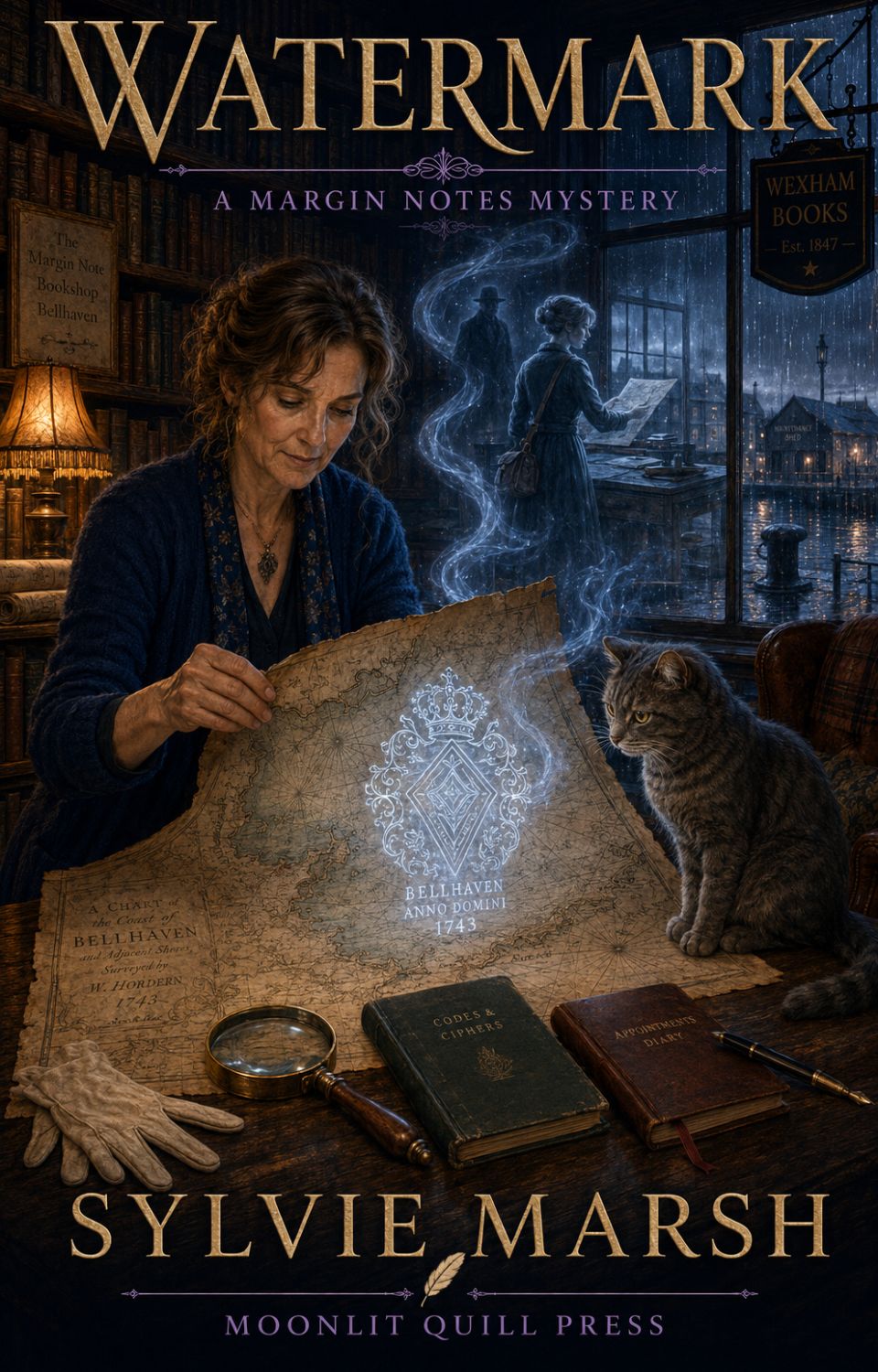
Watermark
By Sylvie Marsh · The Margin Notes Mysteries
Welcome to Bellhaven. Put the kettle on, bring a friend or two, and settle in to talk about Cecily Mallory, the bookseller of The Margin Note, her unflappable shop cat Ptolemy, and the steady, watchful Detective Sergeant Hale.
Before you read
- The story begins with a bookseller unpacking twelve boxes from a late dealer's estate. What do you hope to find in someone else's books and papers, and what would you rather leave unopened?
- In a paranormal cozy, the uncanny usually arrives quietly, through an object, a feeling or an animal who seems to know more than he says. How much of the supernatural do you like on the page, and how much do you prefer left to atmosphere?
- The book is called Watermark. What do you expect a title like that to promise, and what kind of mystery does it suggest to you?
- Most of us rely on experts to tell us what is genuine, whether an antique, a diagnosis or a family heirloom. Whose word do you trust without checking, and what would it take to make you doubt it?
Discussion questions
Spoilers ahead. Finish the book first.
- Cecily has long treated her gift as something "optional," and in the early chapters she admits she is "truly afraid" of what getting involved would mean. Why do you think she kept it at arm's length for so many years, and what finally wore that resistance down?
- Ptolemy speaks to Hale in short, oblique sentences, while Cecily gets only a look from the chair beside the counter. Why do you think the author split the cat's attention between the two women, and did it change how you read each of them?
- Hale keeps a second notebook, labelled C.M. / P., that she would "rather hand in her badge" than let anyone read, and she asks Cecily to write her findings in two sections, citable evidence first and context after. Is that a sensible way to work with an inadmissible gift, or an uneasy bargain?
- Martin Peel and Harriet Osman both behave like people with something to hide, and Cecily dismisses Harriet because her fear is "the right shape for innocence." Is reading fear that way reliable, or did the book simply give her good instincts? Which of the two did you suspect longest?
- Julian Vesey is warm, courteous and always unhurried, with a rueful chuckle and hands that stay "very still." On a second look, which of his visits to the shop now seems most telling, and how does the book make charm feel menacing?
- Hale decides that his stillness was never composure but "the absence of what composure would be there to manage." What do you make of that reading, and why does it land harder than a dramatic confession would have?
- Rowena says the hardest part is "what he did to the trust," and Cecily agrees that his genuine expertise is "harder to put down than the fraud itself." Can knowledge be both real and corrupted at once? What do you make of Hale's line, "Thirty years, and it still wasn't enough for him"?
- Gerald Soane leaves a coded notebook, a draft letter with a blank salutation, a margin note reading "JV aware?" and, at the very end, a scrap that says "Trust the paper." Did you take that note as a message, a habit or a coincidence? How did you feel when Cecily writes "Remains open" beside the question she cannot answer?
- Bellhaven is a harbour town in its grey off-season, where the Heritage Society lends its name to a sale and everyone has an opinion about the viewing. How does the town shape the crime, and what does the book suggest about a community's pride being used against it?
- Cecily solves the case by examining a diary as paper rather than as a source of impressions, and the final proof is something anyone could see in the right light. Why do you think the author let the ordinary craft of a bookseller carry the last step, and what does the framed reproduction in the Local Interest alcove say about the real thing? When Cecily finally says she has "stopped arguing with it," what do you hope comes next for her, Hale and Audrey?
Pairing menu
- Drink
- A strong pot of tea, made first and without negotiation, the way Cecily does it on a cold morning in the back room.
- Bite
- Audrey's lavender shortbread, a recipe she is "still calibrating," brought through the connecting door from Salt & Thread on a plate under a tea towel.
- Setting
- The Local Interest alcove at The Margin Note, with two low chairs, a small lamp, a candle burning near the till and a grey harbour day outside the window.
Haven't read it yet?