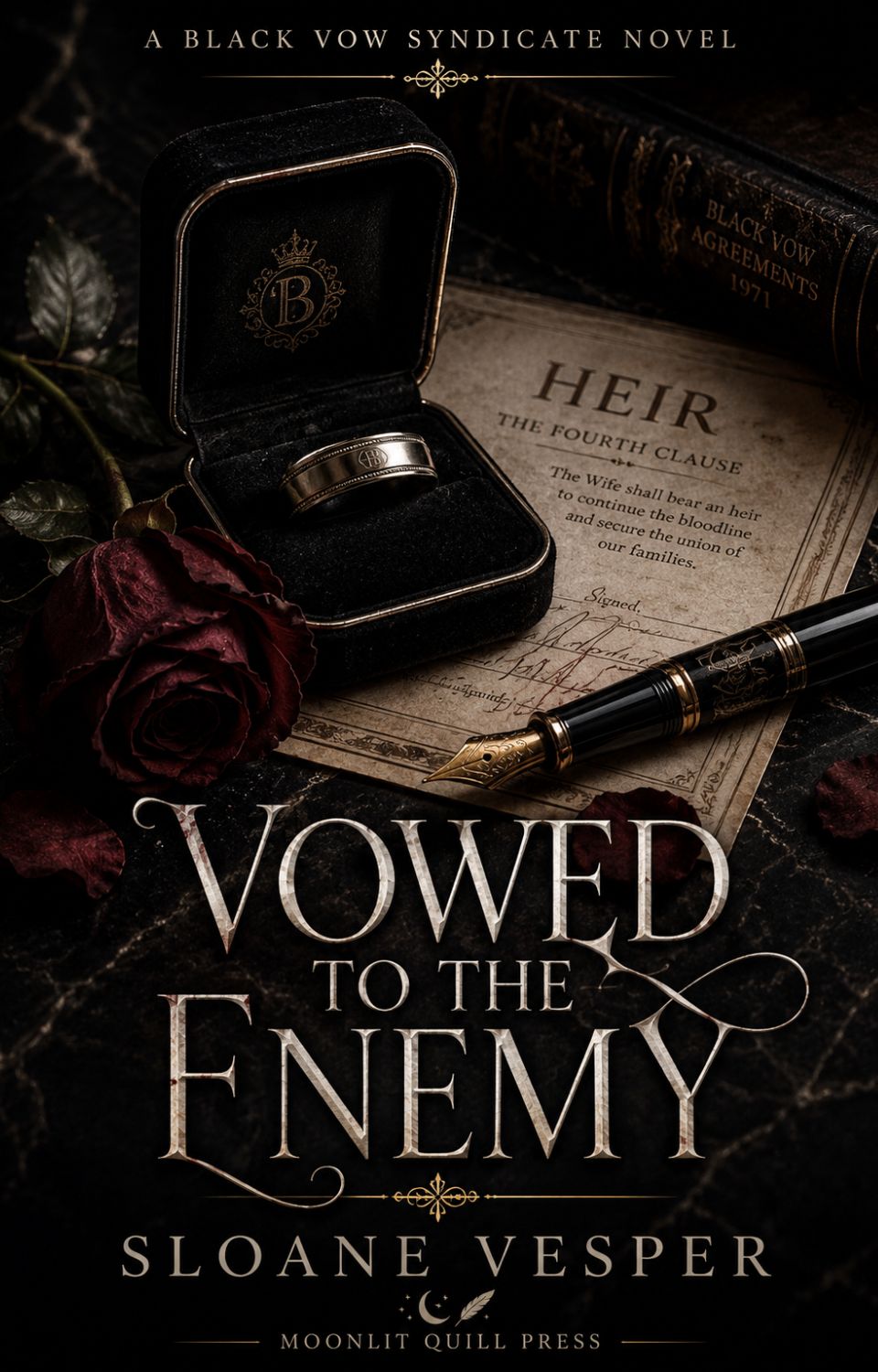
Book club guide
Vowed to the Enemy
By Sloane Vesper · The Black Vow Syndicate
Welcome to a conversation about Christina Moretti and Michael Kincaid, two people from rival crime families who are bound together by a contract. This is a dark mafia romance for mature readers, with a coerced marriage, organized crime violence and morally compromised choices at its center.
Before you read
- The book is built on a marriage that two families treat as a treaty term. What do you look for in a romance that begins with no real choice, and what would make you stop trusting the story?
- Mafia fiction is full of loyalty, money and family obligation. Which of those do you find most compelling to read about, and which feel overused?
- Some romances give the heroine power from the very first chapter, while others let her earn it. Which do you prefer, and why?
- Dark romance often asks readers to enjoy a character they would never want near their own lives. Where is your line between a thrilling antihero and someone you simply cannot root for?
Discussion questions
Spoilers ahead. Finish the book first.
- In the room where the contract is read, Michael pairs the terms Christina cannot refuse with protections she did not request, and he says he wants her consent recorded for "Accuracy." Does offering choices inside a forced situation make those choices real, or does it only make the situation easier to accept?
- Michael later explains why he gave her the right to leave any room: "Because coercion makes poor information." Christina answers, "Then I will remember which ones you let me leave." How do you read the gap between being free to walk out of a room and being free of what happens after you do?
- Christina tells herself she is not accepting a sale but entering the enemy's house: "I accepted entry." She goes in meaning to learn his secrets and pull at the foundations. How does her hidden purpose change the way you read the early scenes between them, and when, if ever, does the plan stop being the whole truth?
- Michael prizes complete, honest answers, and the book treats that honesty as a form of intimacy. It also lets him use it as a tool. When he tells Rachel, "I grant what I can afford to lose," is he being generous, or is permission just control with better manners? The book itself puts it this way: "Peace is terms with better manners."
- Nico is the cousin Christina once tried to help escape, and after eleven years of silence, the first thing he says to her is "The passport still works." She goes on to place him back inside her father's house to gather information, knowing the risk. Does the book want you to see this as strategy, betrayal, or something the characters cannot fully name? Did you want her to choose differently?
- Michael prides himself on clean hands and kills by declining to act, a habit Christina names aloud: "You kill by declining." She sees it for herself in a scene where he lets a man's fate play out, and she does not intervene. Does the book condemn this distinction, excuse it, or simply let it stand? How did you feel about the fact that they find each other more compelling afterward?
- The turning points in their relationship tend to arrive close to danger, and the book keeps stressing spoken permission, a safe word and the right to stop. Does that emphasis make the romance feel more trustworthy, or does it risk tidying up a relationship that began in coercion? How does the book frame the difference between what is forced (the marriage) and what is chosen (what happens inside it)?
- Christina grows up in a house where daughters are asked their opinion only after the men leave the room. By the end, her father says "My heir" in front of everyone. Did that moment feel earned, or did it arrive too late to repair what he allowed?
- Christina lets Adele Ferrante go on believing a comforting answer about her sister, then signs the paper that keeps Adele's false identity in place. She then writes the renewal into Michael's ledger instead of hiding it. Is she doing something merciful, something cowardly, or something the book wants to be both? What do you make of the line "Mercy must never be legible"?
- The ending gives Christina half of Michael's chair, two signatures where there was one, and it does not undo the harm either of them has done. Did the shared power change their relationship, or only make them partners in what they have already done? Do you read the last page as a love story, a warning, or both?
Pairing menu
- Drink
- A small cup of espresso, the cup Carlo leaves untouched in the opening scene, or coffee poured the way Christina pours for her father first.
- Bite
- A slice of Aunt Lena's cake, the kind of thing she sends family home with wrapped in white paper, alongside bread and a plate of eggplant from the Pell Street table.
- Setting
- A kitchen table with a smaller second table pushed near the back stairs, a framed print of Saint Rosalia on the wall, and a lamp left on late.
Haven't read it yet?