Book club guide
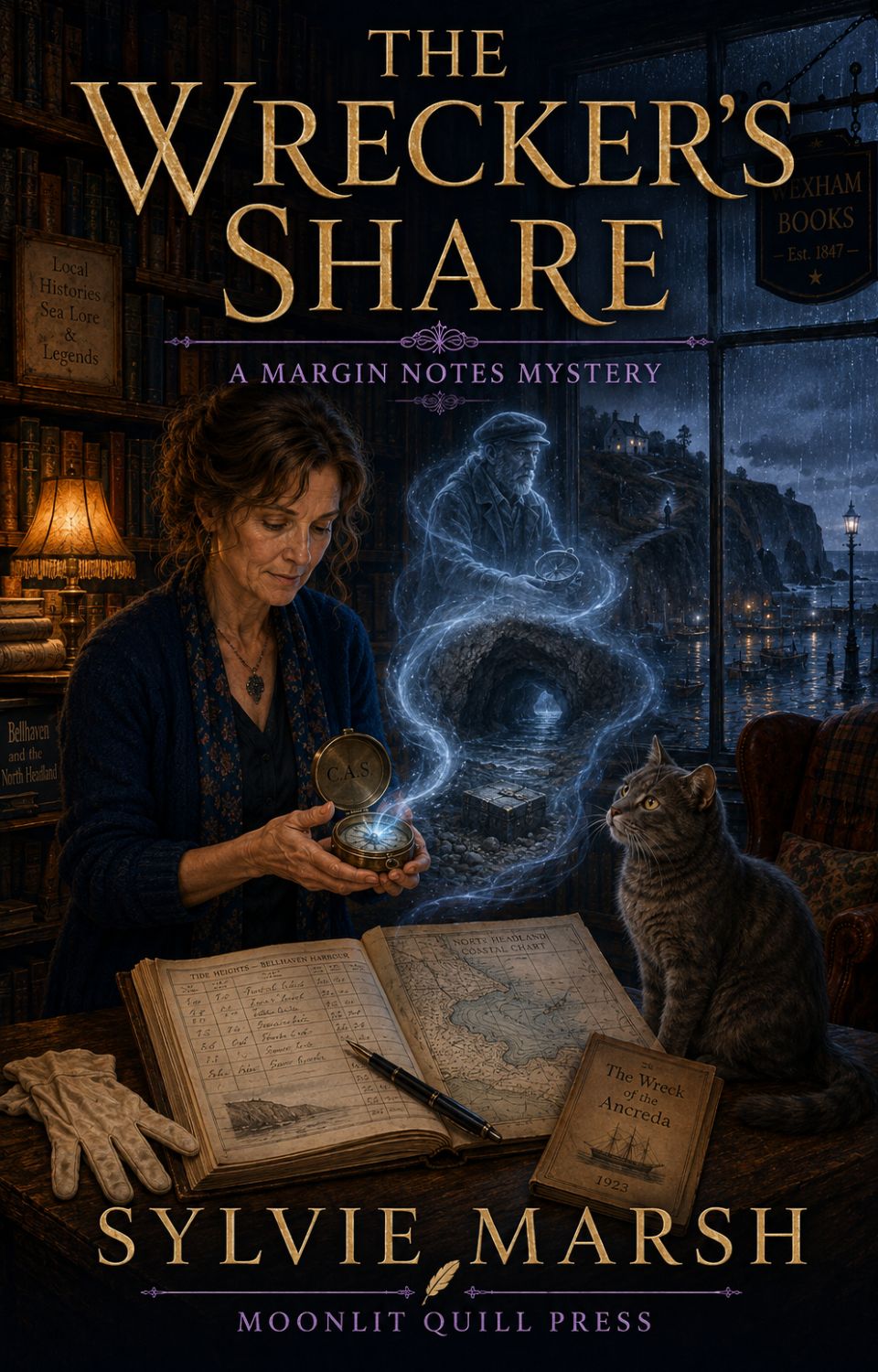
The Wrecker's Share
By Sylvie Marsh · The Margin Notes Mysteries
Welcome to Bellhaven-on-Sea. Pull up a stool at the counter of The Margin Note and settle in to talk about Cecily Mallory, her cotton gloves and her green notebook, and Ptolemy, the large grey cat who always seems to know where he should be sitting.
Before you read
- Cecily is an archivist at heart, a woman who trusts paper, provenance and careful handling. When you are trying to work out what really happened, which do you trust more, a written record or your own instinct?
- The story is set in a harbour town in late October, with grey light, wet cobblestones and a bookshop on Chandler Street. What does an out-of-season seaside setting add to a mystery that a bright summer one would not?
- In this series the sleuth reads objects through touch, and it costs her something each time. Do you like your paranormal gifts to feel like a handy tool or like a burden the character has to manage?
- The book is called The Wrecker's Share. What do you expect a title like that to promise, and what kind of secret do you hope a small town's history is hiding?
Discussion questions
Spoilers ahead. Finish the book first.
- In the first chapter Audrey says, "The trouble with things that wash up is nobody ever asks where they came from." Cecily assumes she means the donations box, and the last chapters circle back to the remark. What do you think Audrey knows, and did you enjoy her staying so lightly mysterious?
- The brass compass engraved C.A.S. gives Cecily the strongest echo she has ever received, including the words "Not yours to take." When she holds it again at the end, the same words land differently. How did your understanding of that phrase change, and why does the book let the compass come home?
- Cecily takes her gloves off only when she has weighed the cost, and the echoes leave her with nausea and darkened edges to her vision. Did you find that price convincing, and was it right that she keeps the echoes out of the evidence she hands over?
- Detective Sergeant Hale receives her own tips from Ptolemy, such as "The old man was not on the upper path," while Cecily simply watches him sit on a shelf. Why do you think the book gives the cat's voice to Hale, and what do you make of the way he watches Cecily in the later chapters?
- Cecily builds her case from the age of the ink, the tide tables, a seven with a diagonal stroke, a signature in a lockbox register and a receipt book. Which piece of evidence did you find most satisfying, and did the book play fair with you about the handwriting?
- Silas Peach arrives with papers in every pocket, a tightly wound eagerness and four years of research, and Cecily quietly rules him out with a plain seven. Did you suspect him, and what did his thank-you at the Heritage Society tell you about the kind of ending this book wanted?
- At the emergency meeting Dunbar sets the key on the table and says, "I didn't go there to do anything." Later, in interview, his account stops before the sentence is finished. How did you feel about a confession that remains incomplete, and what do you think justice looks like here?
- Conal Stredwick believed that "the record has to be able to stand without you." How does that idea shape every thread of the book, from the logbooks and the Crale pamphlet to the minutes Jim Crake writes, and who in the story is a good reader of a record?
- Neve's theory about Allenwick ends with the line "The cave was the destination all along." How persuasive did you find the idea that his strongbox was sent there on purpose, and are you content to wait for the spring dive to find out?
- The Heritage Society is full of fonts, panel wording, clause seven and Mrs. Polsoe's opinions, and yet it becomes the stage for the climax. What does the town's committee life add to this story, and is Rowena the true hero of Bellhaven?
Pairing menu
- Drink
- A mug of tea carried in from next door, the way Audrey brings it to the counter of The Margin Note, or a decent flat white of the kind served at The View café on the cliff path.
- Bite
- A small plate of shortbread, as Audrey sets out in the shop, with perhaps a slice of toast and a jar of marmalade if you want the full harbour-side B&B breakfast.
- Setting
- A cold stone back room with a roll-top desk and a goose-neck lamp making its small circle of light, rain ticking on the cobblestones outside, and a pile of secondhand local histories close at hand.
Haven't read it yet?