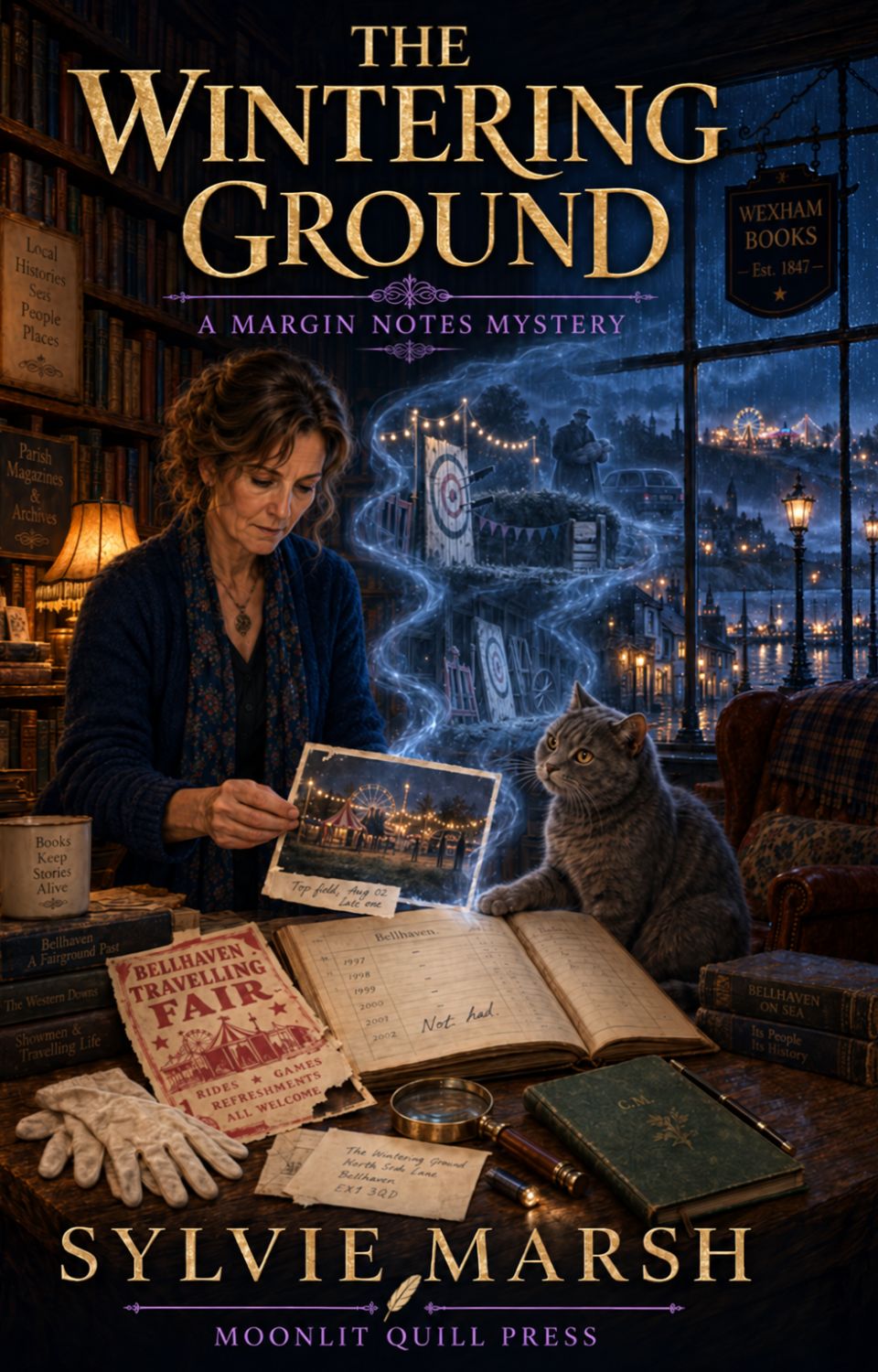
Book club guide
The Wintering Ground
By Sylvie Marsh · The Margin Notes Mysteries
Welcome to Bellhaven-on-Sea. Put the kettle on, find a good chair, and settle in to talk about Cecily Mallory, the bookseller of The Margin Note, her grey cat Ptolemy, and the travelling fair that turns up on the top field with more history than anyone in town remembers.
Before you read
- A fair arrives in a seaside town where, by all accounts, no fair has been seen for a very long time. What do you think a visitor like that stirs up in a small community, and what would you hope it uncovers?
- Small towns often settle on an explanation for a bad event before anyone has checked a single fact. Have you watched a community build a story that quickly, and what made it so easy for everyone to believe?
- Cecily's whole trade is paper: handbills, ledgers, parish magazines, old photographs. Which ordinary documents do you think tell the truest story about a place, and which would you trust least?
- In many cozy mysteries the amateur sleuth and the police keep a careful distance from one another. How do you like that relationship to work on the page, and what rules would you want them to keep?
Discussion questions
Spoilers ahead. Finish the book first.
- In the first days the bakery queue builds a full account of a death in minutes, and Cecily admits she gave "the correct sentence delivered at the wrong volume." When have you let a comfortable story stand because correcting it felt awkward, and what did Bellhaven's habit cost the people in this book?
- Every member of the fair meets DS Hale with the same courteous refusal, "I'd rather not say," and yet they are not lying. Did you read that silence as protection, grievance or something else, and was Sid Gaskin right to keep it up for so long?
- When Cecily touches a handbill soaked in four hundred ordinary evenings, she learns her gift cannot pick out one voice from a crowd, because "A fairground was the opposite of a drawer." How did you feel about a paranormal talent that works only in quiet places, and did the limit make the later readings, the handbill kept by one pleased man and the knife handled by one working life, land harder?
- Ptolemy shows Cecily a hedge and a pale patch of wood at real cost to himself, and at the end she finally says aloud, "I am asking," only to be declined. What is the book saying about what we are entitled to ask of someone, or something, that helps us? Did you find Hale's unexplained short sentences, such as "The field is not theirs to give," as unsettling as she does?
- Hale tells Cecily what she would like to know, and both agree the difference between that and asking is "four inches" wide. Where did you think the line between helping and being used actually fell, for either of them, and did either cross it?
- Four people in the Anchor produce the same sentence, "She went off with the fair," in nearly the same words, and Cecily concludes this is "what being told looks like." Why is a closed sentence so much easier for a town to live with than an open question, and who in Bellhaven benefited from it?
- The truth about Kelly Yeo was never hidden, only unsearched, and Cecily admits that "a search built around a story finds the story." Who do you think failed Kelly and her mother Barbara, the police, the town, the family, or all the people who never asked a second question? Is not looking a kind of wrong?
- Winifred, Terence and Owen Densham each decide what another person could bear, and Cecily's memory of Marguerite suggests she knows that mistake from the inside. Compare those choices. Did you find any of them kind, and is there a difference between keeping a secret and arranging a life around it?
- Cecily asks Nell for four days and cannot say why, while Hale withholds, discloses and documents in turn. Whose handling of what they knew did you trust most, and did Cecily's decision not to share a suspicion that was not proved seem like honesty or like another way of deciding for Nell?
- By the end the case is filed as pending, Owen asks one last question about his father, and Nell arranges for a painted board with her mother's name to join the others in a shed, where the only rule is a name. Which of these closings felt most just to you, and what would you like Cecily and Hale to face next?
Pairing menu
- Drink
- A mug of strong tea, the way Cecily offers it in her stockroom with the advice that Audrey's bottle from Portugal is best avoided, because "the other is a punishment."
- Bite
- A warm sugared doughnut from a fair stall, or a bun from the Chandler Street bakery, whose queue always seems to know the news before the police do.
- Setting
- The wall by the coastal path above the harbour in late gold light, with a green notebook, an old ledger or a box of local ephemera on your knee and a large grey cat somewhere nearby.
Haven't read it yet?