Book club guide
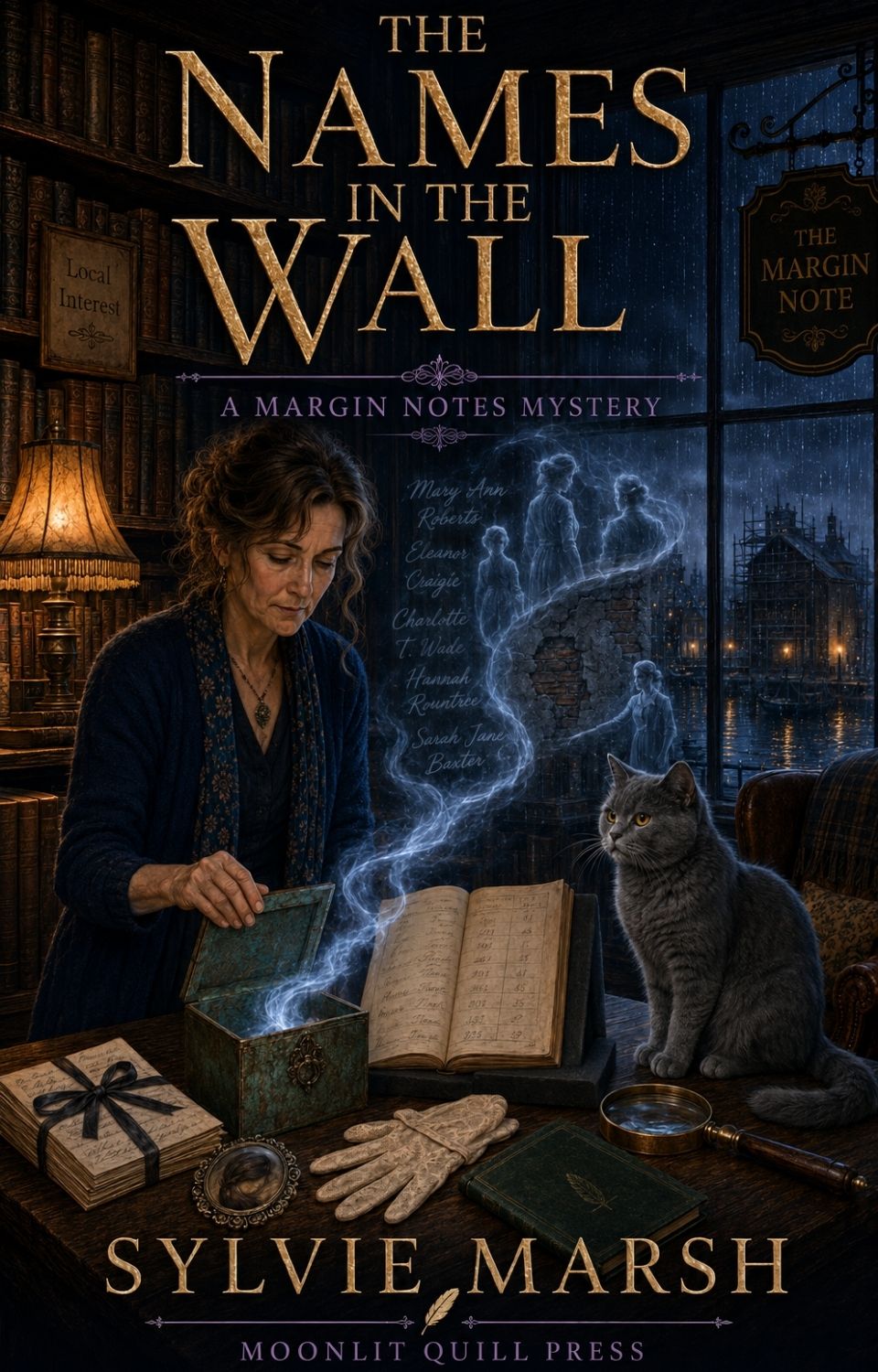
The Names in the Wall
By Sylvie Marsh · The Margin Notes Mysteries
Welcome to Bellhaven-on-Sea. Pull a chair up in The Margin Note, pour something hot, and settle in to talk about Cecily Mallory, her cotton gloves, and Ptolemy, the grey bookshop cat who seems to know which clue matters next.
Before you read
- The story begins in a derelict almshouse in the rain, with a small copper box found behind brick behind plaster. What is it about a hidden object that draws you into a mystery, and what do you hope a box like that holds?
- Cecily is a secondhand bookseller whose touch can wake the history of an object, which is why she keeps her hands covered. How do you like the paranormal to work in a cozy: as a shortcut to answers, or as a burden that makes the sleuth's job harder?
- Bellhaven is a coastal town with a Heritage Society, a restoration committee and a long memory for gossip. What can a small town hold onto for generations, and what does it prefer to forget?
- A Victorian charity, a list of names and a town proud of its past: what do you expect from a cozy that looks at the way communities remember (or tidy up) their own history?
Discussion questions
Spoilers ahead. Finish the book first.
- Cecily repeats "Not proof." to herself and to everyone else, while Hale insists that what she senses is not evidence. How did you feel about a sleuth whose gift can only point a direction, and was the line between impression and evidence drawn fairly?
- Several chapters are seen through DS Hale's eyes, and she alone seems to hear Ptolemy, as in "She smelled of closed rooms before she smelled of paper." Why do you think the author kept the cat's voice with Hale and not Cecily, and what did you make of the quiet exchange at the end between the two women?
- The registry's initials P, S and D stay unexplained until Rowena reads them out in her kitchen. How did you interpret them as you went, and why does "Sent away" feel like the hardest category, the place where the writing stops?
- Daniel Ferris leaves a letter urging Rowena to "keep pressing the blank spaces," and a notebook that admits "didn't argue. should have." How much responsibility belongs to a nineteen-year-old on a survey team, and how much to the adults who told him it was a trustee matter?
- Edmund Pemberton is gracious, sad and evasive, and he insists the almshouses were not a prison before anyone has used the word. Did you feel any sympathy for him? Cecily tells him "Good is not a solvent." Do you agree?
- Patricia Swayne's cream-paper request borrows the language of care, harm review and responsible stewardship, and later she withdraws it in writing. Where does protecting living families end and concealing the past begin, and what did you make of her change of heart?
- Looking back, which clues pointed toward Josephine Carrick: her early questions about names and descendants, the scent Cecily keeps noticing, the face-down form for Carrick Acquisitions Ltd., the four categories she offered over the registry? Which did you catch, and which did you explain away?
- Josephine tells Cecily, "Give cruelty a committee and it learns minutes." Her motive grows from a family story and a career built on handling archives. Is she a villain, a product of the system she describes, or both, and why does the book let her be so articulate?
- Audrey's well-meant questions through Martin Peel about the Carrick properties end up alerting the wrong people, and Hale tells her she has done nothing wrong. Bellhaven is a town that keeps news moving and still hid secrets in walls for forty years, so how did the book use that contradiction, and who carried the most blame?
- The ending offers a marmalade jar of white chrysanthemums and winter roses left by the east wall, Rowena's restorative record and Cecily's remark that "Enough is not restoration." Did the resolution feel like repair, and what do you hope the next book does with Ptolemy, Hale and Cecily?
Pairing menu
- Drink
- A pot of strong tea with a little milk, served in a white cup with a rim of blue waves, the sort of china Audrey Peel keeps for her friends.
- Bite
- Cheese scones with a small bowl of butter, with a tin of "Emergency biscuits" close at hand for when the conversation turns heavy.
- Setting
- A rainy afternoon in a secondhand bookshop, with lamps on among the shelves and rain running down the front window, preferably with a grey cat watching from the window cushion.
Haven't read it yet?