Book club guide
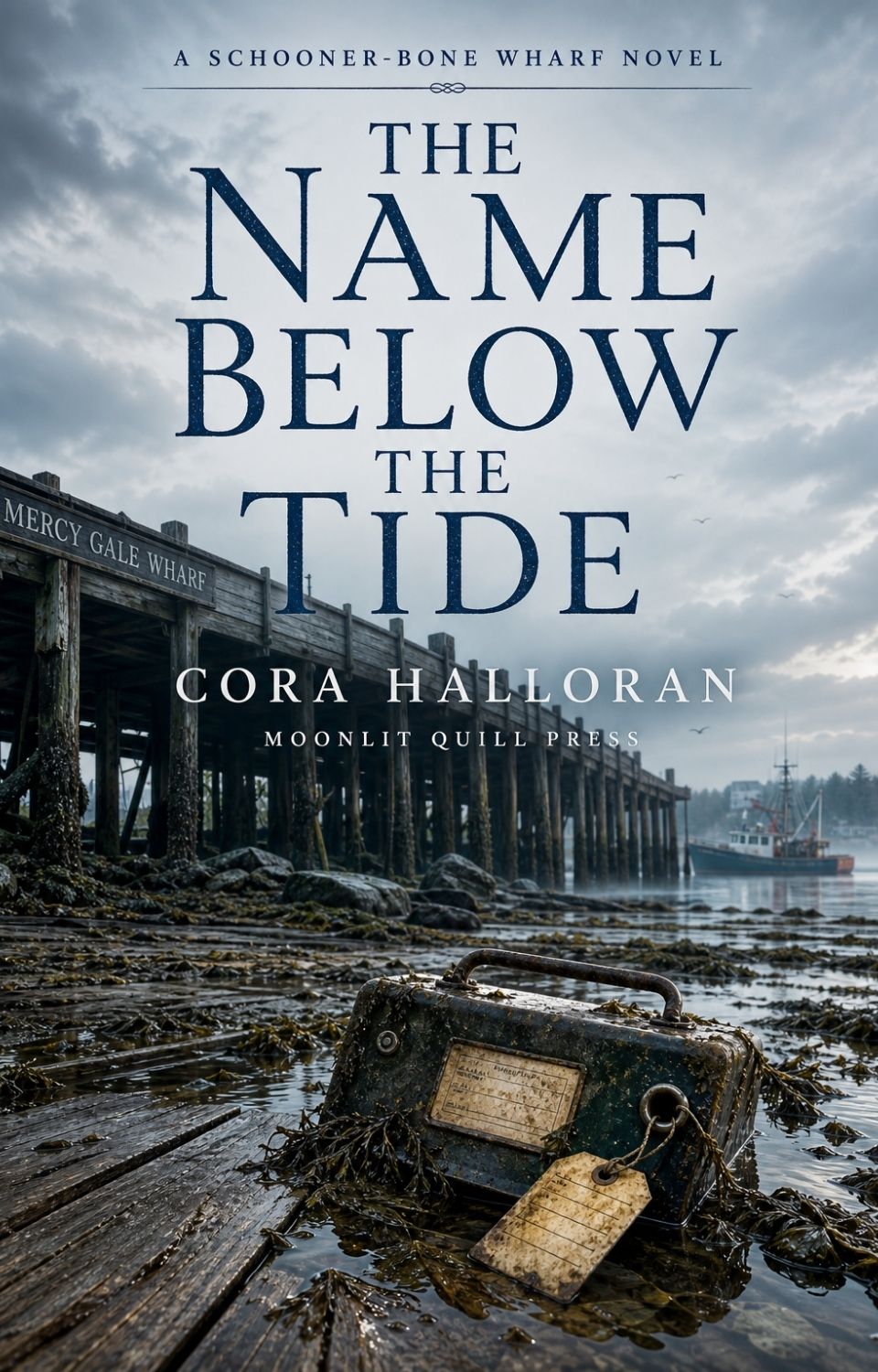
The Name Below the Tide
By Cora Halloran · The Schooner Bone Wharf Of The Barstows
Welcome to Harpswell Reach. Pull up a chair, bring a pot of something hot, and settle in to talk about Mara Barstow, Finn Deveraux, and the two families still tied together by the old timbers of Mercy Gale Wharf.
Before you read
- The title is The Name Below the Tide. What do you imagine a name "below the tide" might be, and which names in your own family have been kept, lost or quietly left out of the story?
- Families save things in odd places: boxes, drawers, account books, photographs, letters tied with twine. Which kind of record do you trust most when the people who made it are gone, and which would you question?
- A working wharf is both a livelihood and a piece of inheritance. How do you weigh a town's need to keep earning against a past that might ask it to stop and look?
- When a hard family truth is on its way, is it kinder to move slowly and carefully or to say everything at once? What does carefulness protect, and what can it cost?
Discussion questions
Spoilers ahead. Finish the book first.
- In the opening chapter Malcolm keeps Annie's letter box dry for decades yet admits he never opened the sealed envelope: "Because I was a coward." When Finn asks whether the box is a letter or a trap, Malcolm answers, "It is both." Does keeping a record safe honor it, or can protecting a truth become another way of hiding it?
- The book keeps insisting on process: Etta writes everything down, Dr. Patel will not move past "convergence is not identification," and the chalkboard at the town meeting promises "Dignity before claim, blame, or rumor." After the opened cavity turns out to hold no remains, Finn says, "And doing it right made us weaker." Where did patience feel like respect to you, and where did it feel like a cost the characters could not afford?
- Bea says of the women who left records, "It makes the rest of us late." Annie wrote letters, Miriam hid facts on recipe cards, Eliza kept the account book and Tessa took photographs. Yet several of them also kept silences, and Bea hid a page in the west wall for years. How does the book ask us to hold the women's courage and their complicity at the same time?
- Annie tells Thomas she took sixty dollars and says, "I have hated that money longer than I held it." She asks that he judge her only as someone who has never had to choose between "a true name and bread." Did you judge her, and did the later discovery about Eliza's torn page change your sense of who paid for what?
- Alden finally admits to Mara, "Because I would not build one with her," meaning he refused to build a record with Tessa about the danger under the wharf. He also hid a Pike letter in a kitchen drawer, and Jonah borrowed from the "Mara fund." What do you make of Alden's slow, partial confessions, and what did you think of Mara's line, "I can thank you without clearing the account"?
- Bea tells Finn that "grief with no grave becomes construction material," and says some people build chapels while others build cages. Malcolm's grief takes the form of shouting at the tape line, while Finn keeps stepping between his father and the people his father wants to blame. At the end Finn says anger would make them "Worse than Annie asked us to be." How do you read the father and son, and what do you think each is protecting?
- Mara and Finn rarely touch. He waits outside the photo lab, he holds the rope instead of grabbing her, and in the final scene they stand with an inch of air between them. Why do you think the story keeps their romance so restrained, and does the restraint feel like caution, respect or something heavier?
- Cal Pike arrives as a creditor, circulates discount flyers about "evidence delays," and then announces, "I am not circling. I am inside it," claiming family standing as Alden's cousin. Is he simply the villain, or does the book make some of his argument uncomfortable? How did the Pike ledgers and the chowder-supper vote shape your view of him and of the town?
- The cavity in the north bay turns out to be empty, but it holds a paler rectangle in the old tar, a board whose size Mara reads as modern, and a folded paper found in a seam. Mara refuses to state the inference she has drawn, noting that something "was drawn out across that face." What do you think the pocket once held, and who do you think reset the board?
- By the last chapter the remains are "most likely" Caleb Barstow, the cause is undetermined, "one beneath and one carried out" is still unexplained, and Bea holds her mother's sealed statement naming Nate as the last person Miriam saw with him. Alden says he cannot prove he never touched that board. What do you hope the statement and the folded paper reveal, and how do you think the wharf's families should carry the name once it is spoken?
Pairing menu
- Drink
- A pot of strong tea poured before any serious talk begins, in keeping with Bea's rule: "Tea first."
- Bite
- A bowl of haddock chowder like the one served in the church basement, or a plate of Bea's molasses cookies, though she would remind you, "Do not eat over paper."
- Setting
- A kitchen table on a foggy, rainy evening, with a low lamp, a small wooden box of old letters tied with brown twine, and the sound of rain at the window.
Haven't read it yet?