Book club guide
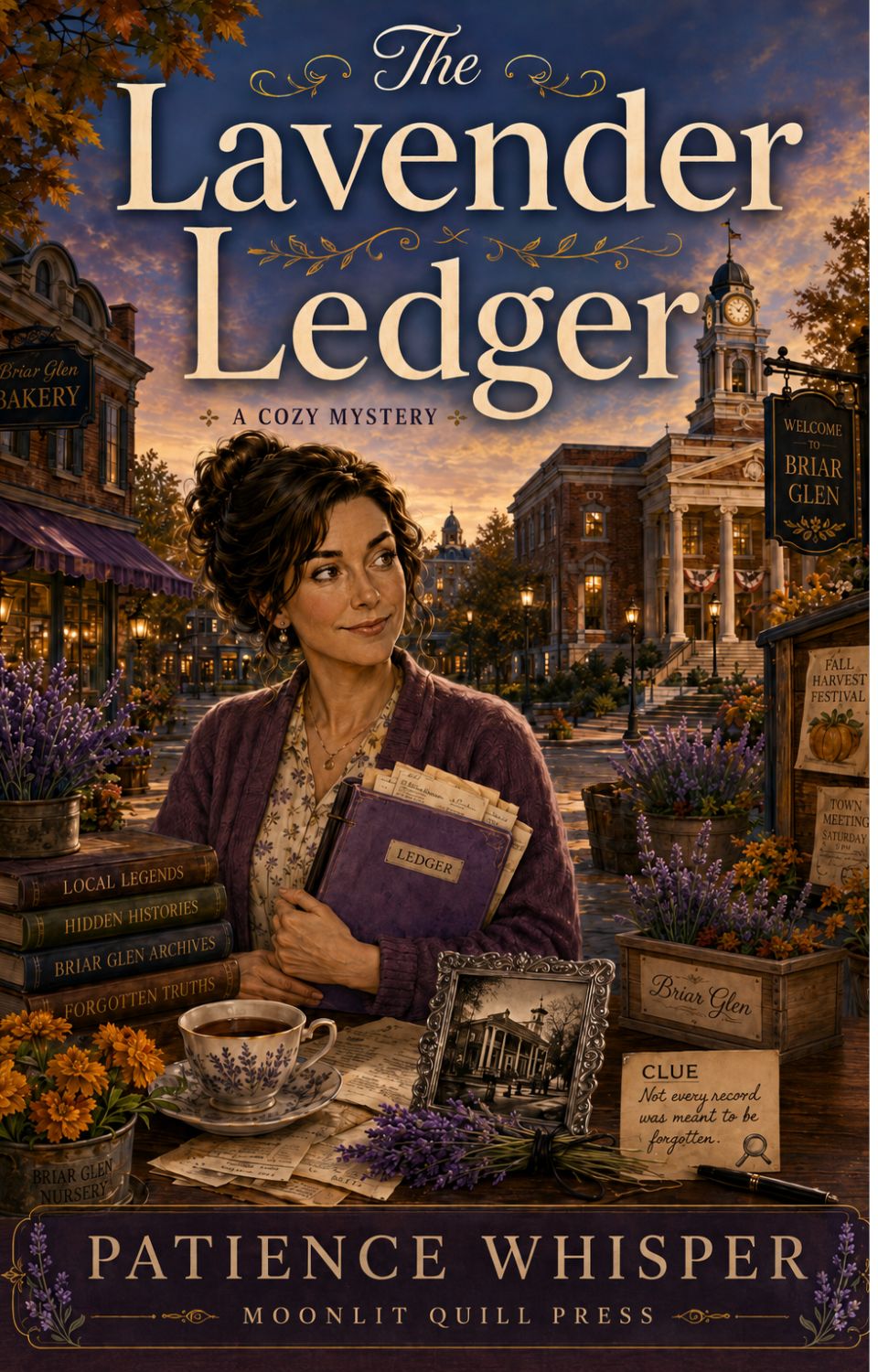
The Lavender Ledger
By Patience Whisper · The Hidden Files Mysteries
Welcome to Briar Glen. Put the kettle on, gather a few friends, and settle in to talk about parole officer Amanda Dawes, her office ally Dotty Marsh, and a small town that has been very sure about one man for twelve years.
Before you read
- When someone comes home after more than eleven years in prison, what do you think a community owes them? What do you think a community usually gives?
- Small towns remember everything and sometimes remember it wrong. How much do you trust the shared memory of the place you live?
- Think of an old photograph or keepsake in your family that you would hate to lose. What does it hold besides the picture itself?
- A cozy mystery promises warmth, humor and a satisfying answer. Can one also handle a heavy subject, like a person who may have been wronged by the law, without losing its comfort? What would you want it to get right?
Discussion questions
Spoilers ahead. Finish the book first.
- Amanda has no business calling Clara Tuttle, and she dresses it up as "confirming whether the report affects the supervision of a parolee." Chief Bell tells her to stay in her lane. When is it right for a professional to bend the rules for the sake of fairness, and did you think Amanda crossed a line?
- In their first meeting Elias says he understands "people will expect me to" break the rules. Later he asks for someone present who "hasn't already chosen the ending." How does the book show what it costs to be judged by your worst chapter, and what did you make of the town's sudden claim in the last chapter that it had always had doubts?
- The clues come as a pattern: silver-framed photographs, a sprig of lavender tied with black thread, notes in a tidy slanting hand, and the line "The wrong man came home. The right one never left." Which clue did you find most unsettling, and which did you find fairest?
- Amanda sees the frame under Elias's floorboard and says someone is staging a performance, and later thinks that a frame job "had a rhythm. Plant the object. Point the finger." How did the book use the planted evidence to keep suspicion moving from Beatrice to Harold to Marjorie to Lydia, and who were you suspicious of at each stage?
- Cora says she wanted to direct Amanda toward the truth and that she framed Elias "only briefly." Amanda answers that there is no brief version of ruining an innocent man. Does a good end excuse a cruel means here, and where do you land on Cora?
- Arthur Bellamy was remembered as jolly, and Marjorie observes that "loud laughter can cover many things." What does the book say about the people a town finds easiest to trust, and did the kindness list and the casseroles look different once you knew how they had been used?
- Many characters held a piece of the truth and kept quiet: Marion Vale, Harold, Marjorie, Chief Leland, Cora. Marjorie says cowardice "can sound very practical when you are alone with it." Whose silence did you find hardest to forgive, and why?
- Henry Dawes believed records mattered because names mattered, and he asked his daughter, "If a thing is true and no one wants it, where does it go?" How did you read Amanda's answer, and what do you make of Beatrice's line that history "is not a cabinet for flattering ourselves"?
- Owen Bell begins as an obstacle, insists that "belief is not evidence," and ends by apologizing to Elias in the town square. Did that apology feel earned? What is the difference between the apology Owen gives and the one Marjorie gives, and why does Elias say hers "isn't forgiveness"?
- The final pages call the mystery ended and the reckoning begun, with Elias "no longer cleared, not yet healed." Did you want a tidier ending? Amanda decides that cozy "was not the absence of darkness" but the lamp lit afterward. Do you agree, and how did the humor from Dotty, Clara and Mrs. Pruitt shape that feeling?
Pairing menu
- Drink
- A cup of mint tea, the kind that goes cold on Amanda's desk, or a thermos of soup in the spirit of Mrs. Pruitt, who believes justice is no excuse for low blood sugar.
- Bite
- Warm scones with jam, in honor of Clara Tuttle, who serves tea at four and expects you on time.
- Setting
- A damp autumn evening on a town square, with orange marigolds in planters and a lamp lit in the window, ideally within sight of a bossy old clock.
Haven't read it yet?