Book club guide
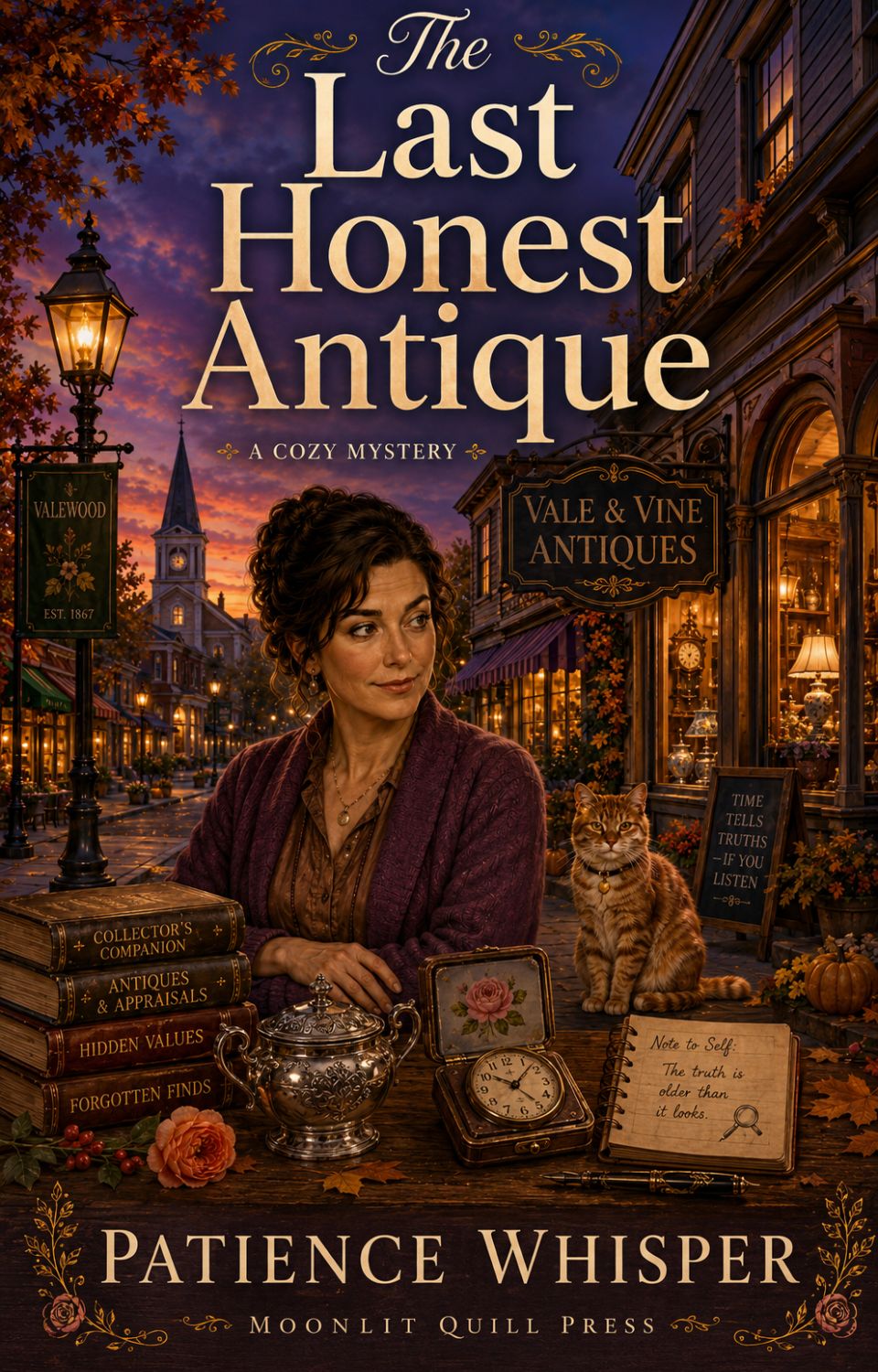
The Last Honest Antique
By Patience Whisper · The Hidden Files Mysteries
Welcome to Brindlewick. Put the kettle on, find a comfortable chair, and settle in to talk about antique dealer Maren Vale, her opinionated marmalade cat Clarence, and a village where the past never quite stays on the shelf.
Before you read
- The heroine is an antique dealer trying to live honestly after years of looking the other way. What would you need to see before you believed someone had really changed?
- Old objects can carry a lot of history, and not all of it is pleasant. Do you own anything with a story you are not sure you know the whole of?
- Small villages in cozy mysteries run on gossip, and the busiest talker in town is often the best-informed. Do you find that character a comfort, a nuisance, or both?
- A cat who seems to know more than the humans is a favorite cozy device. What makes a cat sidekick charming for you, and where does it become too much?
Discussion questions
Spoilers ahead. Finish the book first.
- In the first chapters Maren admits her past to Chief Inspector Lark while standing beside a body, and she says confessing is "not as refreshing in practice as moralists imply." Why do you think she finally told him, and did the book make honesty look hard enough to be believable?
- The ledger codes point at the wrong people for a long time. "B.P." turns out to mean both Bernard Pike and a "back parlor" holding, and Minnie Hartwell's violet buns and a scrap of green wool keep drawing suspicion. Did you feel the red herrings were fair, and which one fooled you longest?
- Reverend Hales is unmasked when Bernard recalls the one man in the village who wears brown tweed every day and walks on the outside of his right boot. Did you suspect him before that moment, and were the clues fair or too well hidden?
- Hales says he meant only to make Quill ill, and then admits he left him. Maren answers that people say "I decided to stop him" usually after someone dies. How did you judge him: as a villain, a coward, or a man trapped by his father's crimes?
- Nora Finch says "Noise can be a fence," and Mrs. Poyle turns out to have been guarding Felicity's secret behind her hats and chatter. Which other characters hide something behind the role the village gives them?
- Maren, Nora, and Minnie all discover that a parent was not simply good or simply guilty. Maren keeps saying such things "are not opposites." Do you agree, and how do the characters decide what to do with that knowledge?
- Felicity Vale's letter says her daughter "must never inherit my silence," yet she also hid evidence for years without telling Maren. Was she protecting her daughter, or leaving her a burden? What would you have done in her place?
- Arthur March wrote that he was "not innocent of fear" but innocent of the theft, and his granddaughter Elsie has carried the shame of that accusation. What does the book say about who inherits blame, and what a family owes its dead?
- Maren begins a Restitution Register, "not a ledger of sins" but a record of repair, and mends a child's china rabbit knowing the join will show. Lark says that usually leaves a visible line. Is repair enough without erasure, and what do you make of the open question of her own consequences?
- Clarence sneezes at poison, topples the kneelers in the undercroft, exposes a fire in a Mayfair office, and ends up with a cushion embroidered "Consulting Cat." Is he a detective, a comfort, or comic relief, and what would the story lose without him?
Pairing menu
- Drink
- A pot of hot tea poured into mismatched cups, the way Maren shares it with Lark at her counter.
- Bite
- Lemon shortbread, Maren's morale-boosting almost-breakfast, or a currant bun or scone from the bakery.
- Setting
- A rainy autumn afternoon in a cluttered antique shop, with a ticking clock, a few chandeliers, and a cat who disapproves of all of it.
Haven't read it yet?