Book club guide
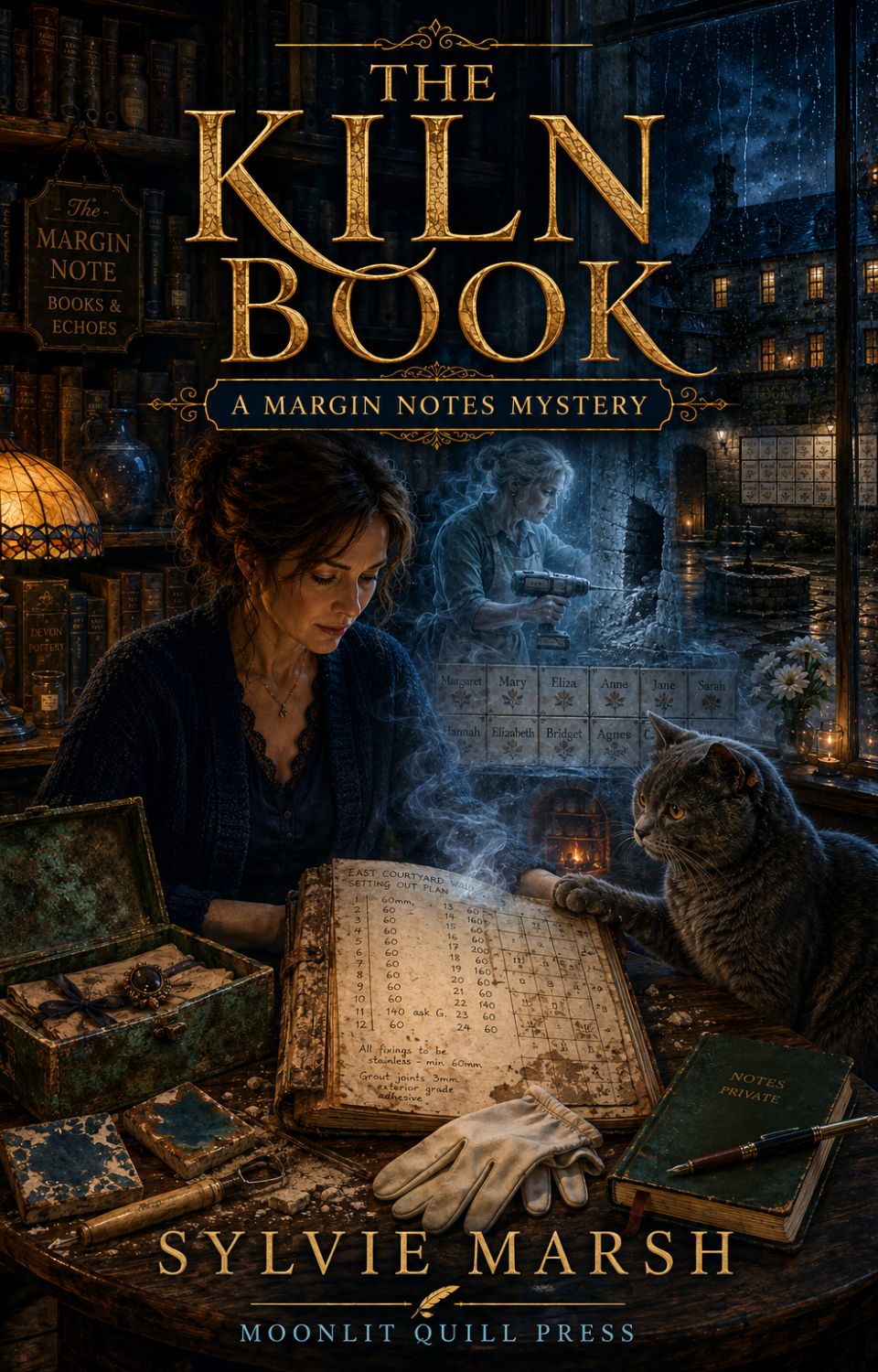
The Kiln Book
By Sylvie Marsh · The Margin Notes Mysteries
Welcome to Bellhaven-on-Sea. Pour a cup of tea, bring a friend or two, and settle in to talk about Cecily Mallory, her bookshop The Margin Note, and the large blue-grey cat Ptolemy, who has firm views on the Local Interest shelf and a good deal else.
Before you read
- Cecily wears thin cotton gloves because old paper and well-used objects can press their history into her hands. If you could sense what an object had held, what would you want to feel, and what would you rather never know?
- The story is set in a seaside town of committees, bunting, a busy bakery and news that travels faster than any official channel. What makes a small town feel like a character in its own right, and what do you hope this one gets right?
- A restored almshouse, a reopening, and a public wall waiting for names: how do you feel about stories that tie a present-day puzzle to a documented injustice from the past? What do you hope they do well, and what do you fear they do clumsily?
- A detective who cannot use what she suspects, and a bookseller who knows things she cannot prove, make an unusual partnership. What do you look for when a mystery separates what a sleuth knows from what anyone can cite?
Discussion questions
Spoilers ahead. Finish the book first.
- Cecily lifts Margot's apron bare-handed and comes away with a conviction: "Someone had already decided." Hale answers with her own rule, that "Right was not a source." How did the book keep the gift from becoming a shortcut, and did the insistence on citable evidence feel like a limit or a strength?
- Hale's route from a folded apron to a usable fact runs through habit, witnesses and a "narrow bridge" she warns Cecily not to decorate. Which small, ordinary confirmation did you find the most satisfying, and which piece of evidence did you most want the sleuths to be allowed to use sooner?
- Gerard Luscombe is the "visible man," warm in every photograph and fluent in sentences that sound generous. Cecily admits she "had begun to resent him for them." Why do polished, helpful people so often slip past suspicion, and how does Rufus Hannaford, who makes himself so easy to suspect, work as a contrast?
- Rowena's appendix places Edith Luscombe's initial beside Margaret Ainsworth's entry, and Cecily builds a motive from it. Rowena insists that "A great-great-grandson is not his ancestor," and a voice in Hale's head says Cecily is looking at "the wrong century." Why is the old wrong so tempting as an explanation, and what did the book gain by letting Cecily be mistaken?
- Rufus's grief shows through his rudeness, and he says, "Death is a generous editor." Margot is remembered by turns as difficult, exact, tender and frightened. Whose memory of her did you trust most, and what did her tiles, her kiln book and her letter to Fen each add?
- To reach Margot's flat file, Cecily uses a lock pick and calls it a "grey area," with the solicitor's list of tasks as her cover. Hale later warns against "an amateur burglary wearing moral shoes." Did you forgive her, and what does the book seem to say about the cost of doing the right thing by the wrong door?
- The Margin Note has its back door worked open, its window cracked by a stone and an envelope waiting on Rowena's doormat. How did the escalating pressure change your sense of who might be behind it, and what did you make of the way it pushed everyone toward the old wound?
- Ptolemy can start contact with Cecily, and afterwards she realises "It costs him something," when he sleeps for hours. Hale says he speaks into her mind but never gives the answer outright. How does this change the way you see him: companion, colleague, or something else entirely?
- The real trouble in the wall turns out to be unglamorous: "Money. Work not done." Martin Peel and Audrey's nephew did two days of skimming in good faith, and Audrey says he thinks "being useful is the same as being safe." Why do you think the author chose an everyday kind of wrongdoing over a hidden Victorian secret, and who in Bellhaven shares the blame for letting it stand?
- In the final chapters Rowena reads all twenty-four names aloud, Rufus fires the last five tiles without being asked, and Hale finally says yes out loud. Cecily concludes that the gift "had not changed" and that she had. What did you want to happen in that courtyard, and what do you want from the next book?
Pairing menu
- Drink
- A strong pot of tea, ideally poured from the "third pot" at Rowena's archive table, or a mug of Audrey's soup from a flask on a cold courtyard evening.
- Bite
- A warm cinnamon bun from the harbour bakery, or crackers with Rowena's cheese, which has become "philosophical" by the afternoon.
- Setting
- A chair near a bookshop window with a large grey cat on the shelf beside you, a stack of old books to sort and, if you can manage it, the sound of gulls and ropes tapping on masts from the harbour.
Haven't read it yet?