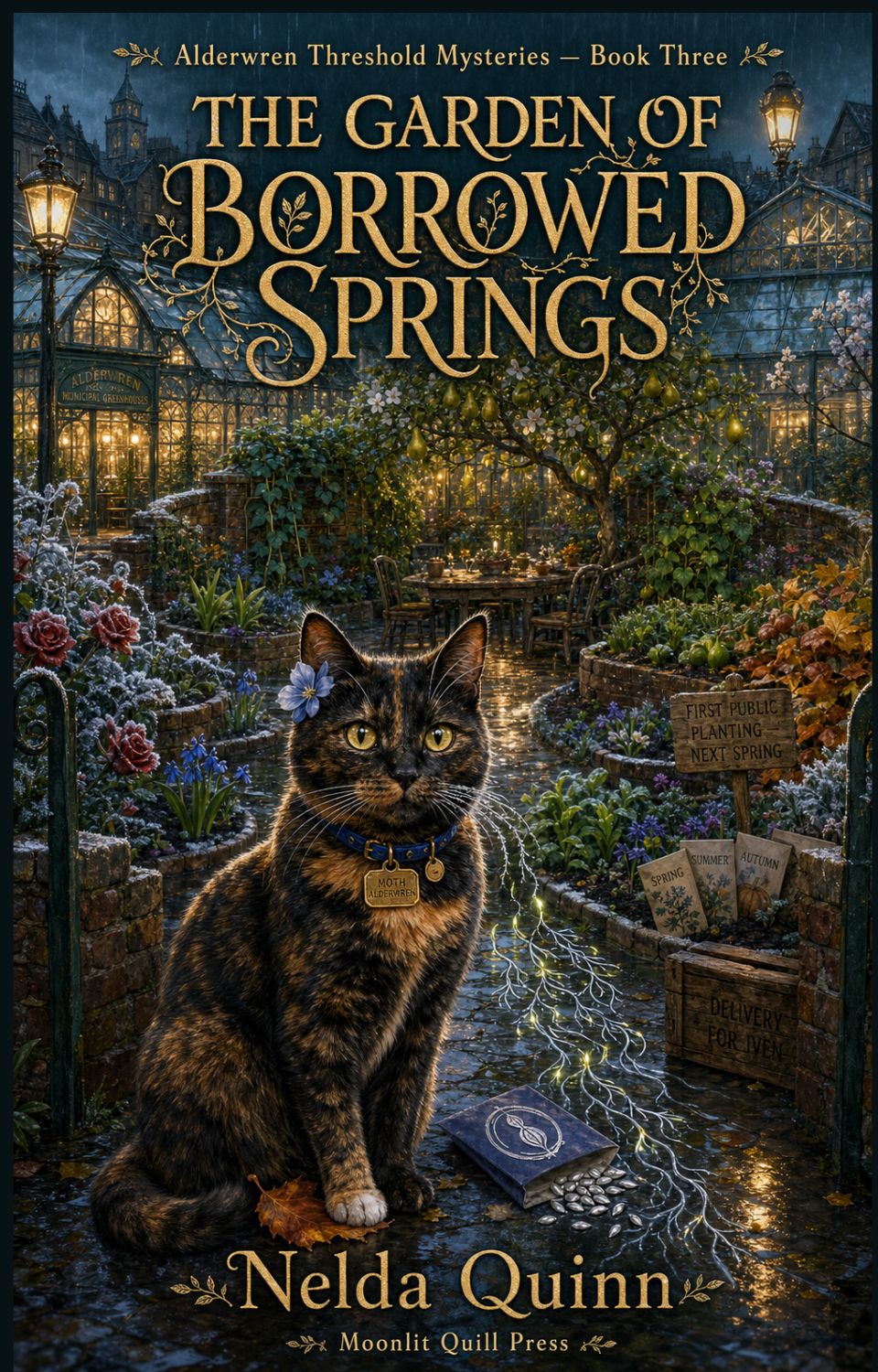
Book club guide
The Garden of Borrowed Springs
By Nelda Quinn · The Alderwren Threshold Mysteries
Welcome to Alderwren, where doors have opinions and gardens keep long memories. Pour a cup of tea, bring a friend or two, and settle in with Angela Lark, her tortoiseshell cat Moth, and a town whose seasons are starting to go astray.
Before you read
- The title promises "borrowed springs." If a season could be borrowed, lent or kept for later, what would you hope that means, and what would worry you about it?
- This series treats doorways, houses and gardens as things that listen and answer back. How much unexplained magic do you like in a cozy mystery, and does a gentle fantastical edge make you more or less eager to follow the clues?
- Think of something you meant to begin and have not: a garden, a shop, a trip, a skill. What does it feel like to carry a plan you have postponed, and who do you tell about it?
- Cozy towns often run on bakeries, tea and a good animal sidekick. What do you want from the food and the cat in a story like this, and what would feel like too much?
Discussion questions
Spoilers ahead. Finish the book first.
- The prologue shows Marian and her daughter Rowan planning a garden whose border is left open on purpose, so that people can leave "without pretending they failed." Marian also says that "Plans are promises with filing dates." Once you knew where the story was heading, how did you read that first scene, and which of the two women did you side with?
- Angela does not accuse, grab or search. She keeps a ledger, asks permission, and asks each person separately what they want returned. Did that method feel satisfying as detective work, and did the book ever tempt you to wish she would simply act?
- Mrs. Rusk's frozen rose, the three-season branch in the Bell orchard, Doctor Shaw's snowbound bench and Clara Fenlow's rooftop all lose something that was never theirs to give away. Which borrowed season moved you most, and what did you make of Doctor Shaw's answer when the greenhouse offered him his brother's last visit: "I want the afternoon"?
- Marian calls what she did rescue, not theft. She says she was saving springs from neglect, and she is also grieving. Did the book let her be both wrong and understandable, and where do you draw the line between protecting something and taking it?
- Iven first speaks through a half-open door and says "I think someone planted me." He is a possibility that looks and sounds like a person. What did the book suggest makes someone real, and did his small discoveries (disliking pear preserve, liking apples, tea with milk) persuade you?
- The stolen seasons come with beautiful futures attached: Mina Cress's sunflower, the rooftop restaurant that is open forever, two elderly Angelas at one table. The book keeps returning to the idea that hope is not an agreement. Why do you think the author made the temptation so warm, and did you ever want Angela to accept one of those futures?
- At the Primrose Bend threshold, Angela names her hopes one at a time and refuses to let them be merged into a single "later spring." Jonas does the same about the shared house he and Angela keep imagining. How did you feel about a romance that stays deliberately unplanned, and about the word "possibly" turning into a running joke?
- Tamsin Rook's guide cloak, Mr. Pell's stack of false renewal forms and Anwen Pike's careful refusals all ask whether doing a job well means you owe it forever. "Current service is not future consent," Tamsin says. Which of them did you identify with, and what did you think of the six-month term Tamsin eventually chooses?
- Mr. Pell's forms, Tobin's baskets, Mrs. Rusk's argumentative clock and the plain brown loaf that is "the only entirely ordinary object" keep the magic from floating off. What does ordinary bread and paperwork do for a story about thresholds and seasons, and which small running joke made you laugh?
- Rowan's last note says the first thing planted in the garden "must be allowed not to grow." The book ends with a Possibility Garden where every gate keeps a way out, a three-month term for Iven, a silver recipe card and a spoon engraved with tomorrow's date. Did the open ending satisfy you, and what do you want from the next book?
Pairing menu
- Drink
- A pot of black tea, poured the way Angela does in the Primrose Bend kitchen, with a pitcher of milk on the side for anyone who likes it.
- Bite
- A pear bun or a slice of seed cake from Tobin's basket, with a plain brown loaf and butter for readers who want something entirely ordinary.
- Setting
- A garden bench on a warm afternoon among larkspur, thyme and rosemary, with a cat nearby and a notebook for writing down what you notice.
Haven't read it yet?