Book club guide
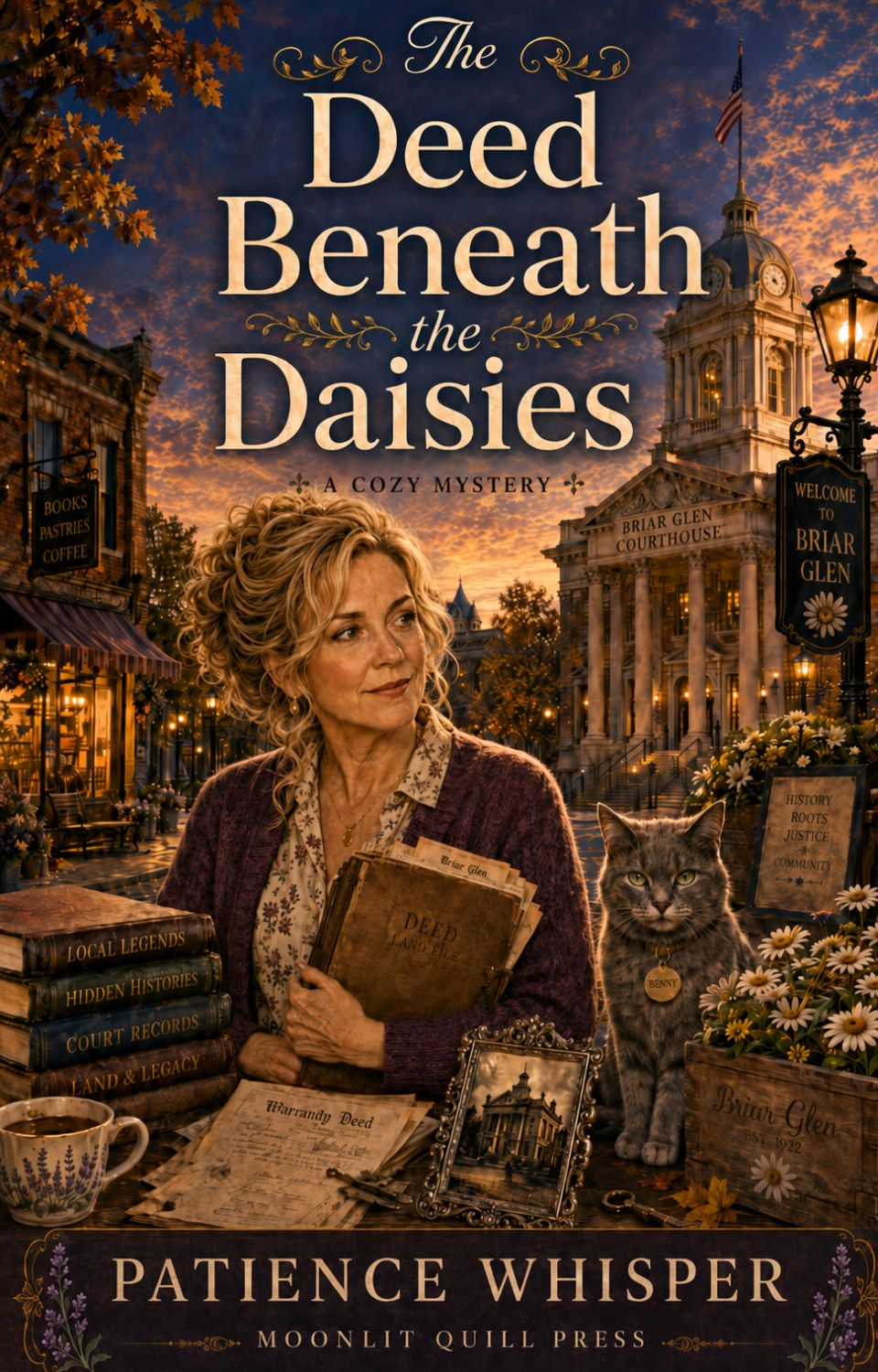
The Deed Beneath the Daisies
By Patience Whisper · The Hidden Files Mysteries
Welcome to Briar Glen. Put the kettle on, bring a friend or two, and settle in to talk about paralegal Blythe Mercer, her opinionated gray cat Bernice, and a small town where the oldest secrets live in the paperwork.
Before you read
- This story begins with a family fighting to keep a piece of land. What makes a place feel like it belongs to a family, even when the paperwork is in doubt?
- Blythe works in a small legal aid office and loves old public records. What do you hope an ordinary, careful record-keeper might notice that a more powerful person would miss?
- Think of the people in your own town who keep its history, whether in a museum, a church, or a kitchen drawer. How much do you trust the stories a community tells about itself?
- Cozy mysteries often give the sleuth a pet who is part comfort, part comic relief, and sometimes part detective. What do you want from a cat in the story, and what would be too much?
Discussion questions
Spoilers ahead. Finish the book first.
- Norah tells Blythe she has a gift "for noticing the trim on the curtains while everyone else argues about the window." Which small details did you notice first, and how did the book reward careful attention over dramatic action?
- Judge Satterfield greets the opposing side's wordy arguments with lines like "That sentence had more hinges than a barn door." How did her dry humor shape your sense of the courtroom scenes, and did it make the stakes feel higher or lower?
- Graham Vale warns Blythe that Eloise Whitcomb "was not what people think," then keeps turning up at the edge of every scene. Did you read him as a threat, an ally, or a young man stuck inside his family's history, and when did your opinion change?
- Eloise donated her packet with a twenty-seven-year restriction, placed copies with the court, and left a third safeguard with Paul Bell. Why do you think she trusted paper and time rather than speaking up in her own lifetime, and what does her line "Do not let paper become more obedient than truth" mean to you?
- Mayor Winston Tully, with his bow ties and his habit of enjoying keys, looks guilty for much of the book. How does the story use him, and Celia Whitcomb's purse, to steer suspicion before the larger picture comes into view?
- Celia says Eloise was "protecting the Whitcombs from themselves," and later confesses to taking Clara's packet. Clara tells her, "That is not forgiveness. That is proper storage." Did the book give Celia the right amount of accountability, and what would forgiveness have looked like?
- Daisy Bell keeps the story of Rose Harlan and her brother Paul in a gingersnap tin until Blythe turns up. Why do you think she waited so long, and how did learning that Paul tried to sell the paper change how you saw Rose's story?
- The scenes at Lavender House show a vulnerable man being asked to sign a statement he does not fully understand. What did Elaine Porter's policies and Paul's lucid, tender moments ("She said the pond road remembers") say about how we protect older people and their memories?
- Bernice finds a scrap of paper in an alley, a key tag, a hidden folder, and a bonnet, and ends up listed as "material witness." Is she the engine of the plot, the heart of it, or a very expensive distraction? What would the story lose without her?
- The book closes with Clara's sign at the meadow and Ruth Ann Harlan's belief that "Late truth is better than none." Do you agree? How does Briar Glen, with its bakery, historical society, and courthouse, balance being a cozy refuge with being a place that kept uncomfortable truths buried for fifty-five years?
Pairing menu
- Drink
- A strong cup of coffee, the kind Blythe buys at Daisybell Bakery before a long day of chasing records (or a mug of tea gone cold, if you want to read like Norah).
- Bite
- One of Daisy's apple turnovers, the ones that "leaned left," or a molasses cookie from her tin.
- Setting
- An armchair near a sunny window with a stack of old papers beside you, or a blanket by a quiet pond at dusk, with fireflies in the reeds.
Haven't read it yet?