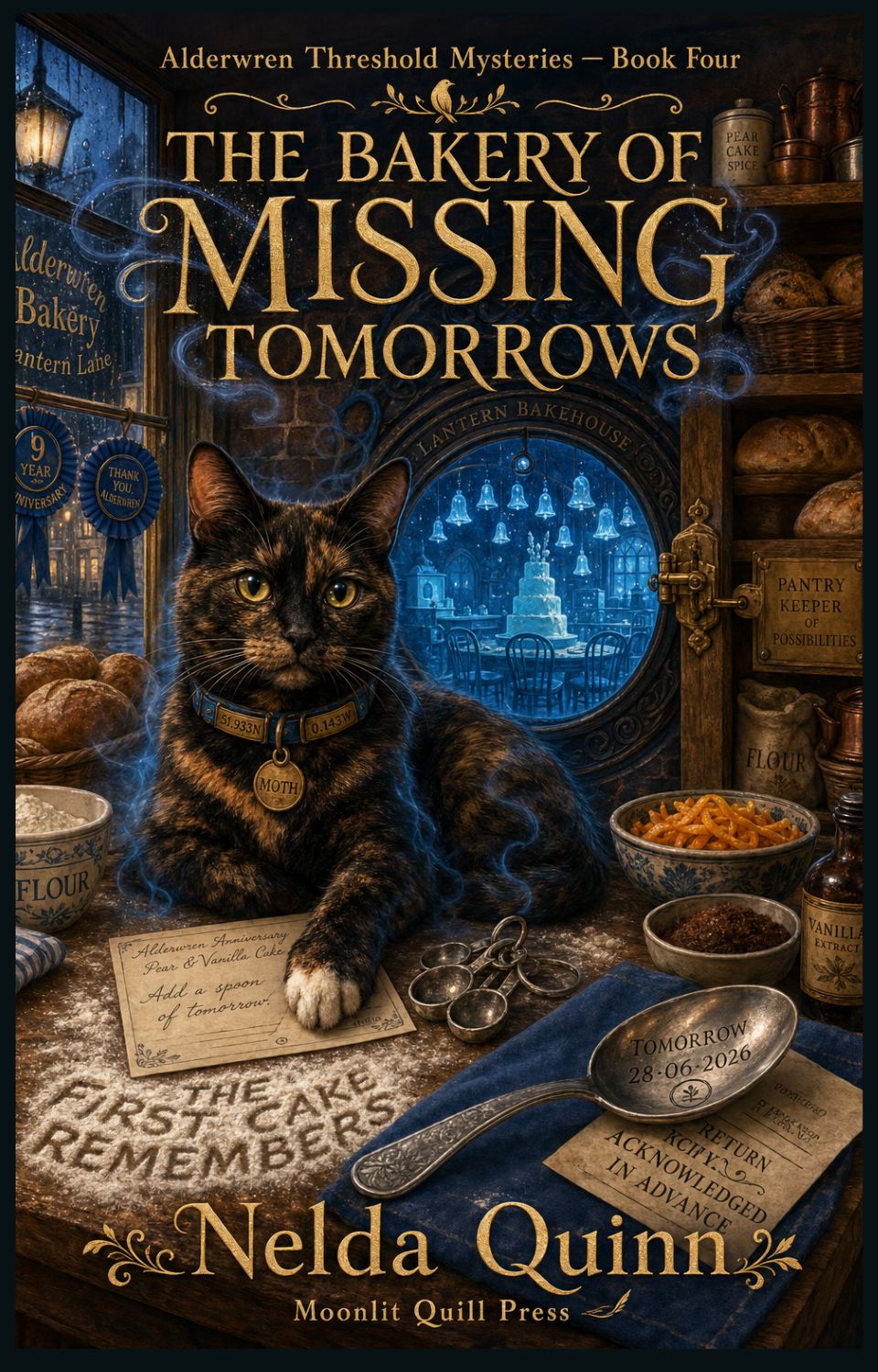
Book club guide
The Bakery of Missing Tomorrows
By Nelda Quinn · The Alderwren Threshold Mysteries
Welcome to Alderwren. Pour a cup of tea, bring a friend or two, and settle in with Angela Lark, Jonas Thorne and his maps, and Moth, the tortoiseshell cat who keeps her own counsel and her own collection of spoons.
Before you read
- This is a town where a chandelier lowers itself when someone says the wrong word and a bakery sign argues about its own opening hours. How much everyday magic do you like in a cozy mystery, and when does it start to feel like too much?
- The mystery begins in a bakery at the start of an anniversary celebration. What is it about food, ovens and a shop that feeds half the town that makes you trust a setting, or watch it closely?
- The title promises tomorrows that are missing. If you could spend a single morning inside a day that had not happened yet, would you want to, and what would you hope not to see?
- Angela is a sleuth who writes everything in a ledger and asks people for their consent before she asks them anything else. What do you want from a detective who works that carefully, and what would you worry she might miss?
Discussion questions
Spoilers ahead. Finish the book first.
- The Prologue takes place thirty-five years before the main story, with Clemency Dorr and Agatha Reed arguing over whether a possible tomorrow can be kind. Clemency says the families' contradictory accounts are not stories but "consequences." Whose side were you on in that kitchen, and did your sympathy shift by the end of the book?
- After the first tasting, the cake leaves Lena and Hugh, Clara, Mr. Pell, Flora and Angela each with a vivid morning that never happened, and Moth carries a slice that spells out "ALREADY AGREED." Pippa puts it simply: the experience happened, the proposal did not. How did you feel about sincere memories that are not true, and which character's false tomorrow felt most real to you?
- Tobin Reed can answer every question the town asks him, and he writes "CLOSED AT FIVE" on the bakery board only after Flora asks to run the afternoon. What did the book say about the difference between being loved and being needed, and did Flora's bargaining for a few managed shifts seem like a fair way for an apprentice to grow?
- Mr. Pell's two false tomorrows pull him in opposite directions: an archive that carries on without him, and one that cannot open its doors unless he is there. Moth then draws out a page of his private flood-claim notes that no one else has read. How did his slow decision to teach Willa Dane strike you, and what knowledge in your own life lives in only one person's head?
- Nera discovers petitions written in her handwriting for people who never asked her to speak for them, and one young man with a wooden tag decides on "MARREN, FOR NOW." Where does helping someone find the right words end and writing their words for them begin, and why do you think the author gave this thread to a character with Nera's history?
- Clemency prepared the road for the oven to wake, and she is also a grieving sister who kept Ambrose's difficult letters in seven labelled boxes and the happy ones in a trunk marked OTHER. Did the book hold her to account fairly? Did the terms set at the review in the last chapters feel like justice, or like something a little more complicated?
- The oven does not predict anything. It grows whatever the town repeats, fears or hopes for, including the quiet word "yet" and the phrase "NO ONE LEAVES UNFINISHED." Where do you see a small-town version of that in real life, the way a whole neighborhood can decide what someone "will obviously" do next?
- Angela wakes inside a future where every difficult conversation with Jonas is already finished, and when they set it beside his own version of that tomorrow, both dislike how neatly it removed them. What did you make of their limited key to Primrose Bend, with its stated terms and its rule that an invitation is still required? Was it romantic to you, and why?
- Agatha chose the end of her preserved time before the story begins, declined to change it when Tobin asked, and spends her last evening critiquing his pears and his glaze. How did that final bake land for you, and what did it say about wanting more time versus wanting endless time?
- Moth chooses which person gets which slice, buries a spoon in a sack of flour and refuses every enchanted cake, then the book ends with a parcel of thirteen keys and the words "ONE DOOR." What do you think Moth knows that the humans do not, and who do you most hope to see behind that door?
Pairing menu
- Drink
- A pot of black tea, with a little milk on the side the way Jonas takes it, poured by someone who does not mind if you linger.
- Bite
- A warm seed roll, brown bread with cheese, or an oat biscuit, honest food of the kind the bakery serves when the town needs grounding.
- Setting
- A table by a bakery window with blue ribbons strung overhead, a ledger and a pencil close at hand, and a tortoiseshell cat watching from the next chair.
Haven't read it yet?