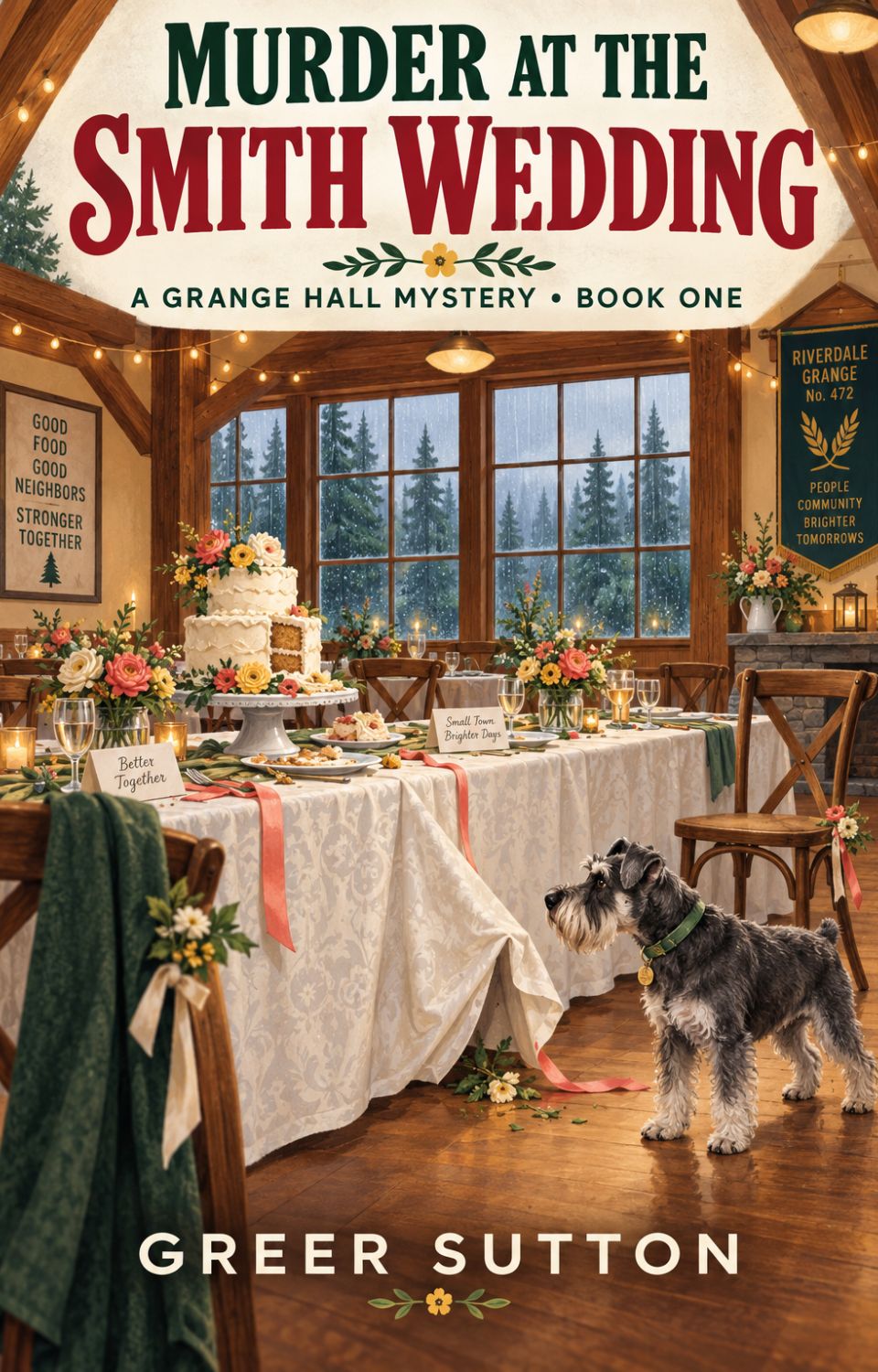
Book club guide
Murder at the Smith Wedding
By Greer Sutton · The Grange Hall Mysteries
Welcome to Renfrow. Pour a cup from the big urn, bring a friend or two, and settle in to talk about Brenda Crane, the hall manager who irons the linen and keeps the Grange running, and her old schnauzer Arnie.
Before you read
- The county wants to sell the Grange hall, and the town's answer is a wedding, an auction and a supper in one weekend to prove the building is still alive. What makes a community building worth fighting for, and which place in your own town would you want to save?
- Brenda spent thirty years as someone "paid to be believed about objects," and she has been back in Renfrow for two years. What do you expect a person with that kind of eye to notice that a sheriff might miss?
- Cozy mysteries love ordinary work: ironing, mending, counting, setting up chairs. What do you enjoy about a sleuth whose skills come from careful, unglamorous routines?
- Coming home to a small town after many years away can mean being welcomed and being left alone to wonder. What do you hope a returning character finds, and what do you hope she is asked?
Discussion questions
Spoilers ahead. Finish the book first.
- When one long damask cloth comes back missing, Brenda writes the number on the rental sheet rather than offering a theory, because otherwise she would have handed over "a story instead of a number." Do you admire her discipline, or did it cost the town time? What would you have said to Sheriff Teague that night?
- When Sheriff Teague tells Dale "That's not an answer" about his missing ninety minutes, he agrees that it is not. Why does he stay silent, and did the book make you suspect him even a little? How does it compare his silence with Andy's, Lucinda's and Mr. Pruitt's?
- Agent Ruiz tells Brenda, "I would rather be wrong," and later the case against Dale goes forward anyway, with Sheriff Teague's dissent written into the file. Everyone in that room follows the rules and the outcome is still unfair. Who, if anyone, is at fault?
- Mr. Pruitt says the resolution "isn't about the building's week" but the county's year, while Walt Smith stands up and says, "I'd take the money." Which of them did you find more persuasive, and what is the Grange hall really for, according to Lucinda's long list?
- Ingrid sits on the hall steps and asks Brenda whether she thinks she did it, and Brenda will not simply say no. She insists on "showing" her why not first. Was that integrity or a hard thing to do to a friend? When is a comforting answer the wrong one?
- Andy knew who took the cash box and kept the girl's name out of it, and Brenda keeps it out of the room full of neighbors too. Was that the right call, given the propane bill, the missing money and the roof fund coming up three hundred and forty-five dollars short? Did the book leave any fair answer?
- For years the town has called Colleen "marvelous" about her mother and never asked her anything else. How does the book turn that word into a kindness and a closed door at the same time? What did you make of the folded jacket, a detail that points toward her and shows tenderness in the same breath?
- The book builds its answer from linen: a scorched weave, a store log with a missing line, a hem mend, a deed recorded days before a death. Did you suspect Colleen early, and which clue felt fairest? Teague tells Brenda "You did not solve it," and the final object is listed as "Object not recovered." Did you want more, or did the ending suit this kind of story?
- A page of the Grange's 1953 minutes turns up inside a quilt, with a reservation kept out of the record, and it has nothing to do with who killed Ray Nissen. Why do you think the story keeps that thread, and how did you feel about Mrs. Haugen's decision and Brenda's careful wording of where the page was "deposited"?
- Brenda tells Dale about the coverlet she was right about, "before somebody is kind to you," and she once asked Lucinda "Why have you never asked me?" By the working-day scene at the end, what has changed for her, and what has not? What does the book suggest about being right, and about being asked?
Pairing menu
- Drink
- Coffee poured from a big urn, the way it is at the seniors' lunch, with a second cup for whoever sits down next to you.
- Bite
- A pastry from a paper bag, broken in half and shared across a table of folded linen, the way Lucinda does it.
- Setting
- A table by a north-facing window with a freshly pressed white cloth on it, a dog asleep underneath and a radio turned low.
Haven't read it yet?