Book club guide
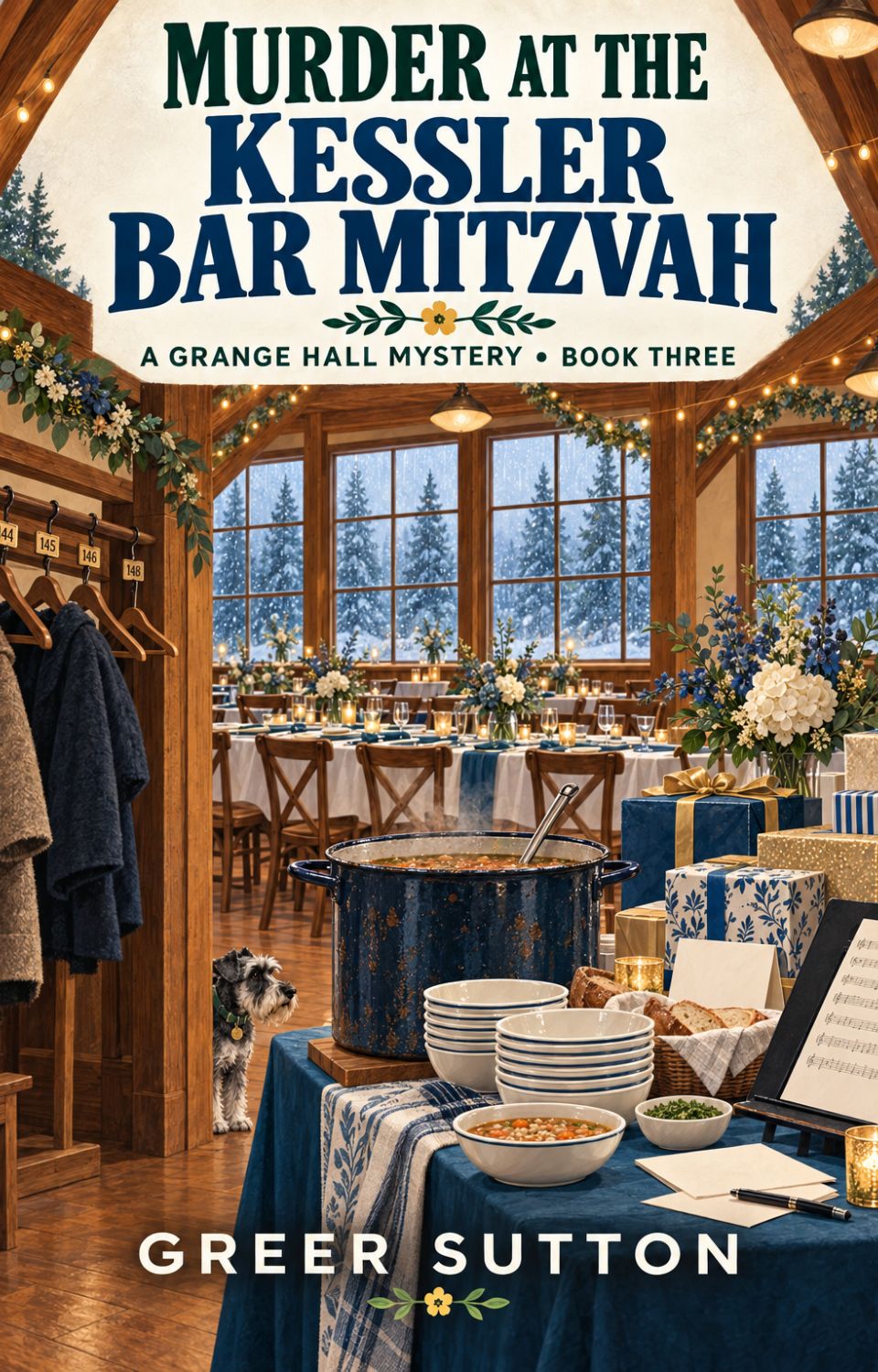
Murder at the Kessler Bar Mitzvah
By Greer Sutton · The Grange Hall Mysteries
Welcome to Renfrow. Pull up a chair, bring a bowl of something warm, and settle in to talk about Brenda Crane, the keeper of the grange hall, her faithful old dog Arnie, and the bar mitzvah lunch that nobody in town will forget.
Before you read
- The story centers on a big family celebration in a small-town hall, with half the guests from the town and half from Portland. What do you expect when two communities share one room and one meal, and where might the friction show up?
- Brenda is not a detective. She runs the building, sets out the chairs and keeps the books. What can the person who manages a shared space notice that the professionals might miss?
- Think of a dish in your own family that carries more than flavor, one tied to weddings, funerals and holidays. Why do some foods become the thing a whole community leans on?
- Small towns often run on an unwritten code about what you ask and what you leave alone. What do you value about that kind of privacy, and what does it cost?
Discussion questions
Spoilers ahead. Finish the book first.
- Brenda's coat rail is introduced as a bit of housekeeping: numbered hangers handed out in order, and a lettered card reading "PLEASE TAKE THE NEXT HANGER." When did you realize the system was a clue, and how did the book make something so ordinary feel important?
- Before the party, a message on the machine asks for "the lady with the Tuesday booking," and Brenda writes down the question mark rather than raising it with anyone. Why do you think she kept it to herself, and would you have done the same?
- Renfrow produces theory after theory: Portland's guest list, a county man sent about the sale, a deli van at the side door. Lucinda sorts the gossip into two piles. How fast did the rumors take shape, and which one did you believe at the start?
- Wendy Zeller put up her hand and said "Wait, please" to an old man in the lobby, then lived with the guilt of it. What does the book say about small, hurried choices that look different in hindsight?
- Brenda asks Vicki Urrutia where she lived before Renfrow, then later tears up the copy of the deed. Was the question reasonable, was the apology enough, and what did you make of Vicki's line "The rest of it's mine to know"?
- Ellen Yates and Linda Coyle turn out to be the same woman. Merle Quinlan kept his son's letter for years, and the sheriff tells us he sat through a trial where the truth was in the room. How did you feel about each of them, and who do you think the book asks us to grieve?
- Opal says simply, "I fed Ellen," and Noah says she only came because he asked her to play. How does each member of the Kessler family carry what happened, and what did you make of their reactions?
- Sheriff Teague gives Brenda a rule: if she is not sure, she brings it anyway and says so. Brenda then lays out her "Four things" without claiming certainty. Did she handle the knowledge responsibly, and what would you have done in her place?
- Opal says the hall "never once asked what anybody was." Brenda herself came home after decades away to a town that rarely asks. By the end, what has the hall protected, and what has the habit of not asking cost?
- The final scene has Hannah sit on the piano bench for the low part that had been Ellen's, with Noah playing the hard bar beside her. What did you take from that moment, and did the ending feel like healing, an echo of loss, or both?
Pairing menu
- Drink
- A cup of strong, hot coffee poured from a small urn that ticks away at the end of a long table.
- Bite
- A bowl of beef and barley soup with bread on a board, stirred from the bottom, the kind that has fed a town at harvest suppers, funerals and parties.
- Setting
- A lamplit table by a frosty window with a quilting project in your lap, snow falling outside, and a stack of folding chairs waiting along the wall.
Haven't read it yet?