Book club guide
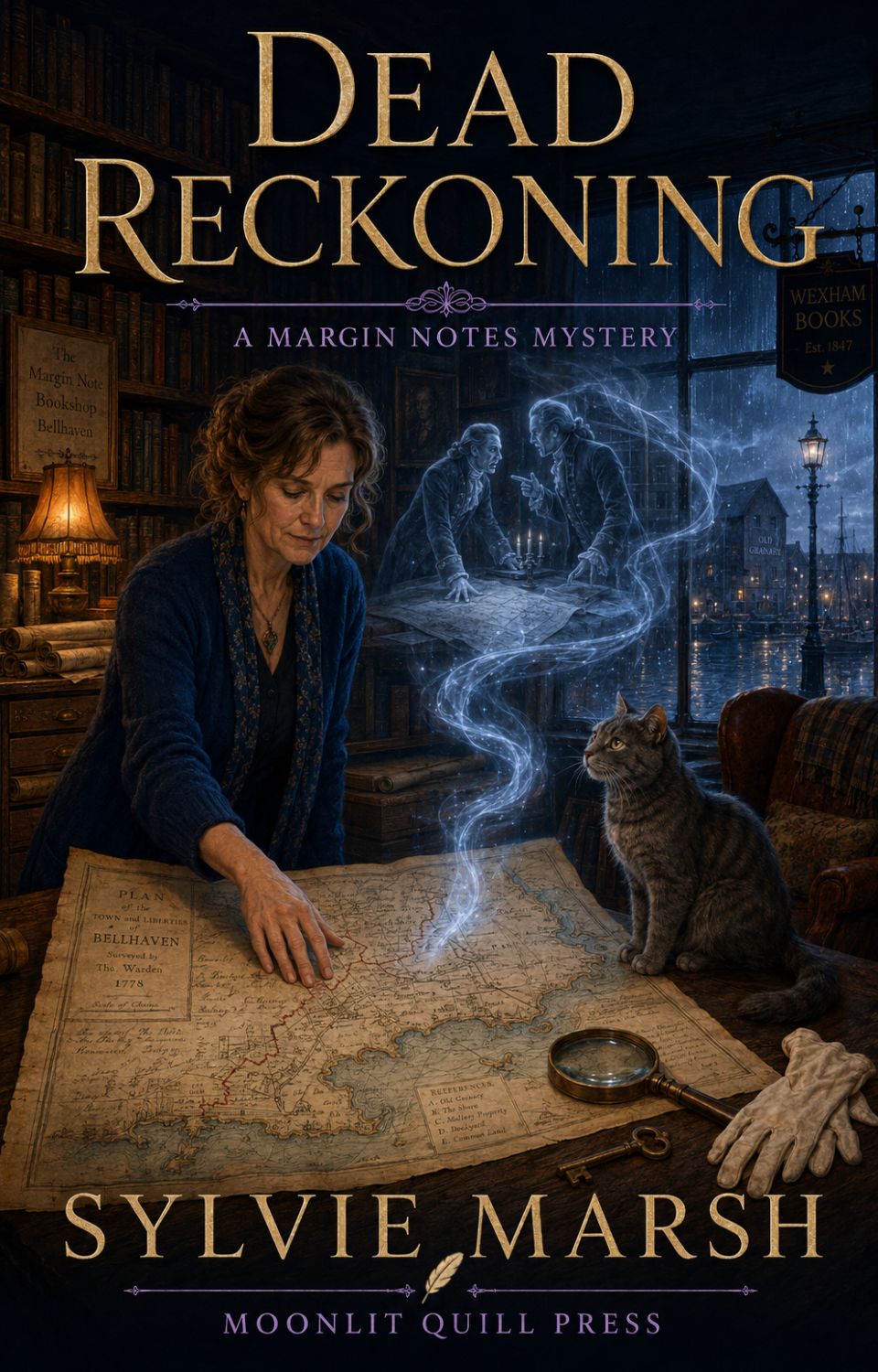
Dead Reckoning
By Sylvie Marsh · The Margin Notes Mysteries
Welcome to Bellhaven. Pour a cup of tea, settle in by the woodstove, and talk over Cecily Mallory, her bookshop The Margin Note, and Ptolemy, the large grey cat who seems to have opinions about everything.
Before you read
- The book opens in a secondhand bookshop where a respected dealer sells a very old map. What draws you to stories set among old paper, shelves and quiet shops, and what do you hope such a place can hide?
- Cecily has a gift that works through touch, and her grandmother called it "touching the echo." In a paranormal cozy, how much should a sleuth's gift explain, and how much should it leave in shadow?
- Bellhaven is a harbour town where everyone seems to know everyone's business. What can a small coastal community notice that outsiders would miss, and what can it be blind to?
- Many readers love a cat who watches more than he lets on. What would you want from a feline companion in a mystery, and what would be too much?
Discussion questions
Spoilers ahead. Finish the book first.
- The shop's bell has been stuck on a delay since August, and Cecily notices small wrongnesses all over the shop: a scratch near a keyhole, a latch left open, a tube tied with the wrong knot. Which small detail did you notice first, and how does the book reward readers who pay attention to the little things?
- Cecily's visions arrive with the smell of the sea, tallow and fury, yet she is "never shown enough." Did you enjoy a gift that gives her leads and not answers? How did her notebook with its three columns (Saw, Suspect, Check this) change the way she used it?
- In chapter 20 Cecily touches Gerald's pen and sees Rowena at the storage unit, then works out that she has read a present fear and not a past act. Did you believe the misdirection, and what did it cost you to doubt Rowena, even briefly?
- Dominic Aldermoor has the obvious motive, the polished charm and a hidden tie to the development money, yet he is not the killer. Why do you think the book lets him stay close to the centre for so long, and is the way he walks away from the wreckage punishment enough?
- Gerald's calendar reads "per D," and Cecily first assumes it means Dominic. How did the book use the dead man's own habits, his surnames and his knots, to correct her, and did you suspect Fletcher before the middle name arrived?
- Fletcher Oade says, "I didn't mean for it to happen the way it did." Cecily sees in him a fear of losing the small life he had built. Is that fear enough to make him sympathetic, and where does it stop being an excuse?
- Gerald could have trusted a solicitor, the Heritage Society or the police with his work, and he chose a bookseller. Why do you think he trusted the way she kept her Local Interest section, and what does the book suggest about whom we trust with what we most want kept safe?
- Imogen Hale spends most of the book politely unconvinced and does not tell Cecily everything she hears. What did you make of the scene where Hale hears the cat speak, and what does it add that Cecily herself never learns it?
- Cecily plans the emergency meeting so the evidence is laid out in sequence and the name comes last, in front of a roomful of witnesses. Did that feel like justice, a trap, or both? What would you have done differently with an official case that has been closed?
- The book closes with a second reference in Gerald's notebook, underlined twice, that Cecily has not yet looked up. What do you think it points to, and what would you like Cecily and Ptolemy to uncover next?
Pairing menu
- Drink
- A mug of strong tea held in both hands, the way Cecily takes it on a cold October morning, or a flat white at a window table in Tansy's.
- Bite
- Something warm and cinnamon from a café kitchen, followed by Sunday lamb as they serve it at The Sounding Line.
- Setting
- A reading chair beside a woodstove with a cat close by, a bay window onto a cobbled street, and a gold wash of sea light across a shelf of old maps.
Haven't read it yet?